Real Estate
4 Steps to Prevent Photo Misrepresentation Risk for Property Marketers
Protect your business by implementing clear photo editing guidelines, ensuring your property images are both appealing and compliant with legal and ethical standards.
By Hospitality Lens · · 13 min read

Editing a listing photo to fix bad lighting is safe. Editing it to imply a bigger room, a different view, or a pool that isn’t there creates real legal, professional, and reputational exposure under deceptive-advertising law and industry ethics rules. Before you publish anything questionable, stop, preserve the original file, and document what changed. The rest of this guide covers exactly where that line sits, which laws and standards enforce it, and what a compliant editing workflow looks like.
Image quality can influence how people evaluate a listing, but there is no universal performance uplift that applies to every property. Measure clicks, inquiries, bookings, or sales on the individual listing. Material changes, such as adding a pool or removing structural defects, are unlawful unless clearly disclosed with labels or paired original images in compliance with MLS and legal standards. Removing metadata or watermark information can cause copyright liability and hinder demonstrating a truthful edit trail, increasing legal risks. Use approved editing practices like exposure correction, perspective adjustment, and minor decluttering, and always document and retain original files and change logs. For routine enhancements, disclose virtual staging and heavily altered photos with labels, and prefer vendors that provide paired images and detailed edit manifests.
HospitalityLens
hospitalitylens.com
Enhance Property Photos Truthfully
Turn usable phone or listing photos into realistic, booking-ready images while preserving the property’s real rooms, views, and features.
Try one photo freeTable of Contents
Understanding Photo Misrepresentation Risk in Listing Images
Photo misrepresentation risk means the chance that an edited image changes a material fact about a property, in a way that would leave a buyer, guest, or renter feeling deceived once they saw the space in person. That’s the practical test worth applying to every edit: would a reasonable viewer feel misled if they walked in expecting what the photo promised? If yes, the edit is risky regardless of how small it seems on screen.
Ethical real estate editing draws a clear line between enhancement and fabrication. Routine, low-risk edits include:
- Correcting exposure, white balance, and color cast so a dim phone photo looks like the room actually looks in daylight
- Straightening verticals and correcting lens distortion (perspective and horizon correction)
- Cropping to a better composition
- Minor decluttering, like removing a trash can or a cord on the floor
Edits that cross into photographic authenticity problems include adding or removing structural features, fabricating a view that doesn’t exist from that window, changing the apparent size or layout of a room, or editing out a visible defect a buyer would reasonably want to know about. The National Association of REALTORS® frames this as a “true picture” obligation: listing photos have to reflect the property’s actual current condition, not an aspirational version of it, according to NAR’s own guidance on when photo enhancement goes too far. The distinction isn’t about how advanced the editing tool is. It’s about whether the finished image still tells the truth about the space.
Legal and Industry Rules That Govern Misleading Images
Several overlapping frameworks apply to real estate and hospitality imagery, and most professionals only know about one of them.
At the federal level, Section 5 of the FTC Act prohibits deceptive practices in commerce, and that standard extends to imagery used to market a property or unit, not just text claims. It’s a broad standard: intent to deceive isn’t required, only that a reasonable consumer would likely be misled by the image.
The National Association of REALTORS® builds a narrower, industry-specific version of that same idea into its Code of Ethics. Articles 2 and 12 require members to avoid exaggeration, misrepresentation, and concealment of material facts, which the association has explicitly applied to enhanced and staged listing photos.
California has gone further with a statutory rule. AB 723 requires conspicuous on-image disclosure whenever a listing photo has been materially altered, plus consumer access to the unedited original, and willful nondisclosure can be charged as a misdemeanor under this 2026 MLS compliance framework.
A pattern worth watching: Regulation is shifting from informal guidance toward statutory requirements. MLSs are now operationalizing disclosure through paired image ordering and on-image labels rather than leaving it to agent discretion, following AB 723’s compliance model.
Major MLS systems and portals increasingly build these disclosure expectations directly into their upload rules, and enforcement isn’t limited to a warning email. Depending on the violation and jurisdiction, it can be civil, administrative through a licensing board, or in rare cases criminal.
Where Everyday Edits Turn Risky
Most misrepresentation problems don’t start with obvious fakery. They start with an edit that seemed reasonable in isolation but changes what a buyer or guest expects to find.
- Virtual staging without labeling. Adding furniture to an empty room is common practice, but publishing it without a visible “virtually staged” label or a paired original photo leaves viewers assuming the furniture is real.
- Adding or removing features that affect value. A pool, a finished basement, an outbuilding, or a view of water or mountains all factor into price and buyer expectations. Editing any of them in or out is a materiality problem, not a cosmetic one.
- Sky replacement and extreme wide-angle stretching. Swapping a gray sky for a blue one is low risk if the property itself is untouched, but an ultra-wide lens that visibly distorts room proportions can misrepresent size just as much as a fabricated wall.
- Metadata or watermark removal. Stripping metadata to hide edit history can create separate legal exposure. Copyright management information is protected, and removing it can trigger DMCA-related liability on top of the misrepresentation issue.
When an edit falls into a gray area, ask three questions: Does it change a fact a buyer would want to know? Would the answer differ once they toured the property? Is there a labeling or disclosure step that would resolve the ambiguity? If disclosure fixes it, disclose. If it doesn’t, don’t publish the edit.
What Happens When Images Mislead Buyers or Guests
The consequences scale with how material the misrepresentation is, and they rarely stay contained to just one photo.
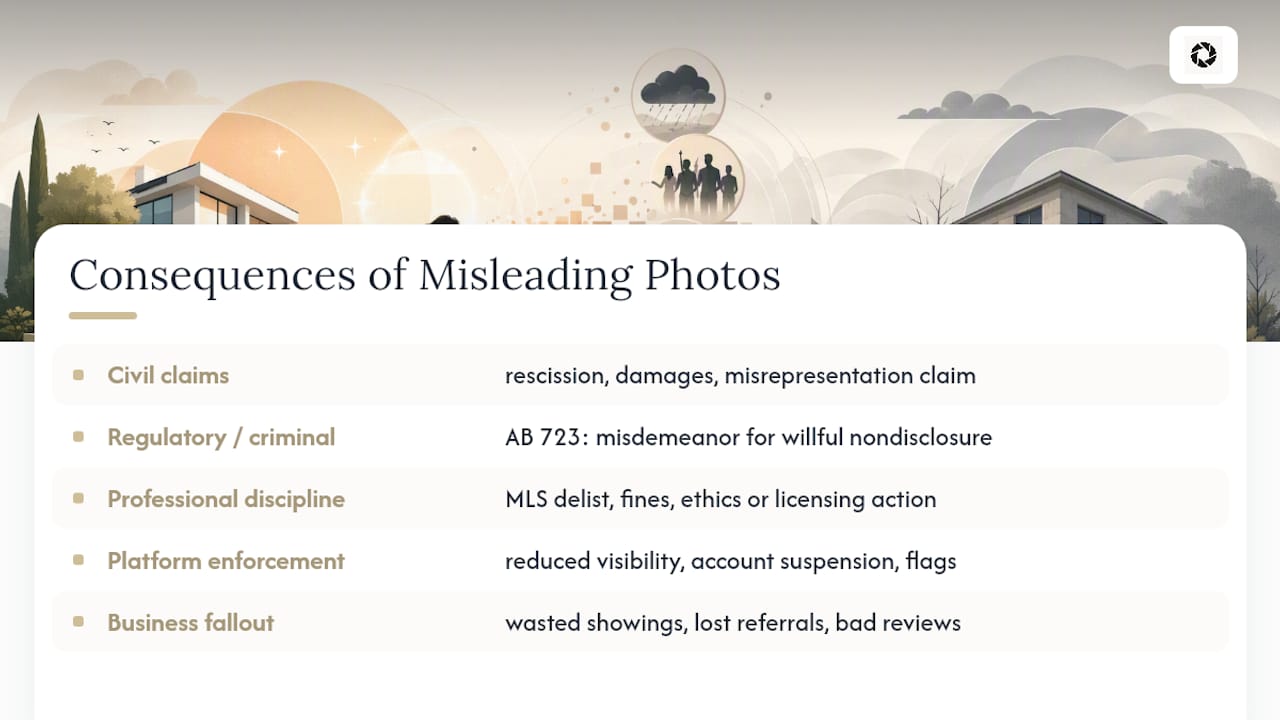
On the civil side, a buyer or renter who feels deceived by listing imagery has grounds for rescission of the contract, damages, or a misrepresentation claim, especially when the edited feature factored into the purchase price. Some state statutes go further, converting what would otherwise be a civil dispute into a regulatory matter. Under AB 723, willful nondisclosure of a materially altered photo can be charged as a misdemeanor, a notable jump from the reputational risk most agents associate with a bad photo choice, per the same compliance analysis.
Professional discipline is the more common outcome in practice. MLS boards can delist a listing, issue fines, or refer the agent to an ethics complaint process. State licensing boards can pursue their own disciplinary action independent of the MLS.
Cross-industry precedent: AI-enabled image manipulation has already produced enforcement and retraction problems in scientific publishing, where detection tools are catching up to manipulation techniques faster than most editors expect. Real estate and hospitality platforms are building similar detection into their upload systems now.
The quieter cost is business fallout: a showing where the property doesn’t match the photos wastes the buyer’s time and the agent’s credibility in the same visit. Image quality can influence how people evaluate a listing, but there is no universal performance uplift that applies to every property. Measure clicks, inquiries, bookings, or sales on the individual listing.
Building an Edit Trail That Protects Your Business
Every image distortion risk gets smaller once you can prove what was changed and why. Four steps cover most of it.
- Create an edit manifest for every photo. Log who made the edit, what was changed (exposure, perspective, object removal), and when. This single document is what turns “we didn’t mean to mislead anyone” into a defensible paper trail.
- Publish paired originals alongside edited images, or make the unedited version available on request. Pairing is becoming standard MLS practice for materially altered photos, not just a best-practice suggestion, based on current editing-ethics guidance.
- Add on-image labels or adjacent notices for staged or heavily altered photos. A small “virtually staged” tag costs nothing and removes the ambiguity entirely.
- Contract vendors to deliver originals, edit logs, and a manifest with every batch. This shifts operational compliance risk onto a documented process instead of an individual editor’s memory, and it protects you if a vendor’s output is ever questioned.
Pro Tip: Set a retention rule of at least the length of your listing agreement plus one year for every original photo and its manifest. If a dispute surfaces after closing, you’ll want the file, not a vague memory of what the room looked like.
Our guide to real estate image preparation walks through a fuller version of this checklist for teams building the process from scratch.
A Practical Checklist for Ethical Enhancement
Reliable, low-risk enhancement comes down to five habits repeated on every batch of photos, not a single policy document nobody reads.
- Only enhance features that genuinely exist in the property; never add, relocate, or remove structural elements
- Disclose any material edit, including virtual staging, with a visible label or a paired original
- Keep every original file, unedited and with metadata intact, for the life of the listing plus a retention buffer
- Get sign-off from the property owner or manager before publishing heavily edited images
- Prefer vendors and tools that hand you paired files and an edit manifest automatically, rather than a single flattened image with no history
|
Acceptable enhancement |
Requires disclosure/labeling |
| Lighting and color correction |
Yes, standard practice |
No |
| Perspective and horizon correction |
Yes, standard practice |
No |
| Clutter or object removal (non-structural) |
Yes, if the object isn’t a defect being hidden |
Situational |
| Virtual staging |
Only with labeling |
Yes |
| Adding/removing structural features or views |
No |
Not acceptable regardless of disclosure |
Human oversight matters more here than tool choice. Industry guidance consistently recommends a person reviewing every AI-assisted edit before publication, precisely because automated tools don’t understand materiality the way a trained editor does. Our guide to hospitality image standards covers how to apply the same checklist across a hotel or vacation rental portfolio rather than a single listing.
How Truthful Enhancement Fits a Compliant Workflow
HospitalityLens was built around the same line this article draws: fix what’s real, never invent what isn’t. The service corrects lighting, color, and perspective, cleans up clutter, and removes stray people or objects from an existing photo. It does not add rooms, fabricate views, or generate amenities that don’t exist in the property.
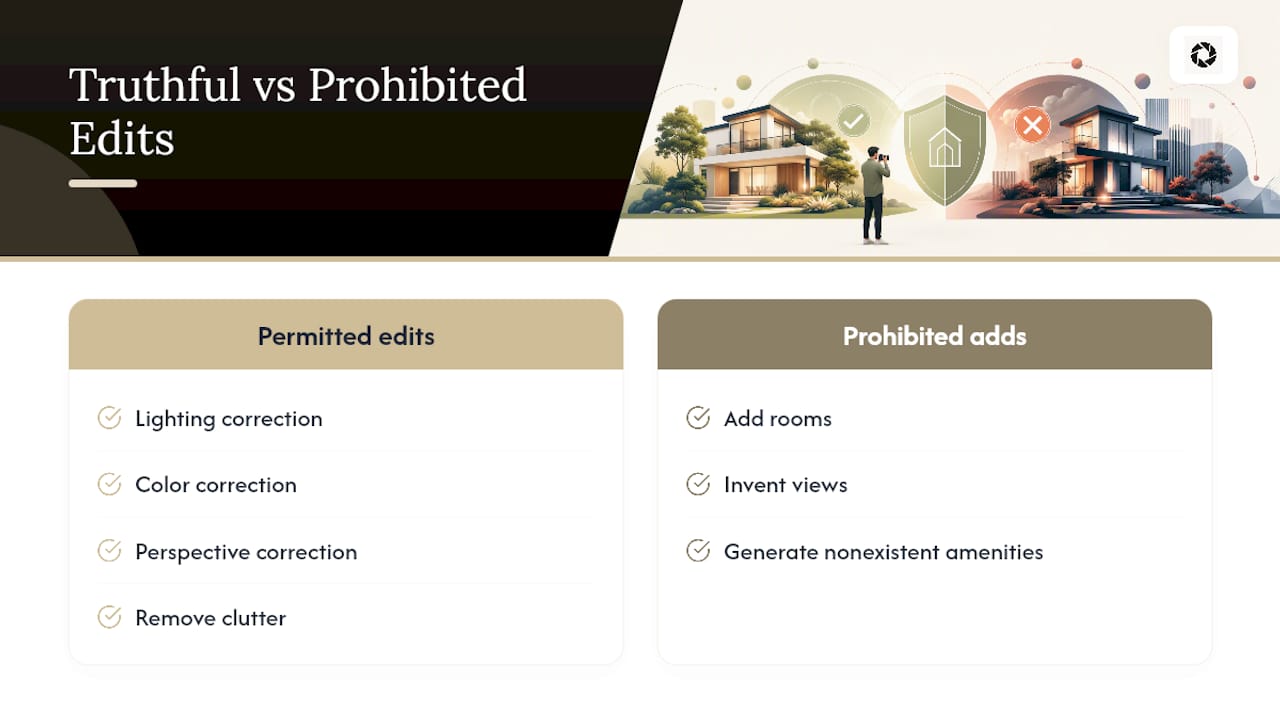
Every order starts as a free watermarked preview, so you can check fidelity before paying anything, and each completed photo includes revisions and access to the original file, which supports paired publishing where your MLS or platform requires it.
A professional photographer is still the better call for a flagship property launch, architectural work, or a major renovation reveal, where new angles and lighting setups matter more than fixing what a phone already captured. Our property photographer directory is a good starting point for those jobs.
Why Truthful Images Are a Business Decision, Not Just a Compliance One
We’ve watched enough underperforming listings to know the pattern: the photos that “sell harder” often convert worse once a guest or buyer actually shows up. A gap between the photo and the property doesn’t just create legal exposure, it erodes the trust that gets someone to book or make an offer in the first place.
Balancing marketing pressure against buyer expectations isn’t optional, it’s the job. We’d rather a listing photo undersell a great property slightly than oversell an average one and lose the relationship on arrival. If you’re unsure whether your current photos cross that line, run one through a free preview and judge the fidelity for yourself.
— The HospitalityLens Team
Try a Compliant Enhancement Before You Book Another Shoot
If your listing photos are dark, crooked, cluttered, or just look like what they are, a smartphone snapshot from a cleaner or an owner, you don’t need a full photoshoot to fix them. HospitalityLens corrects lighting, straightens perspective, and cleans up clutter without adding a single feature that isn’t already there, which is the whole point when photo misrepresentation risk is on your mind.
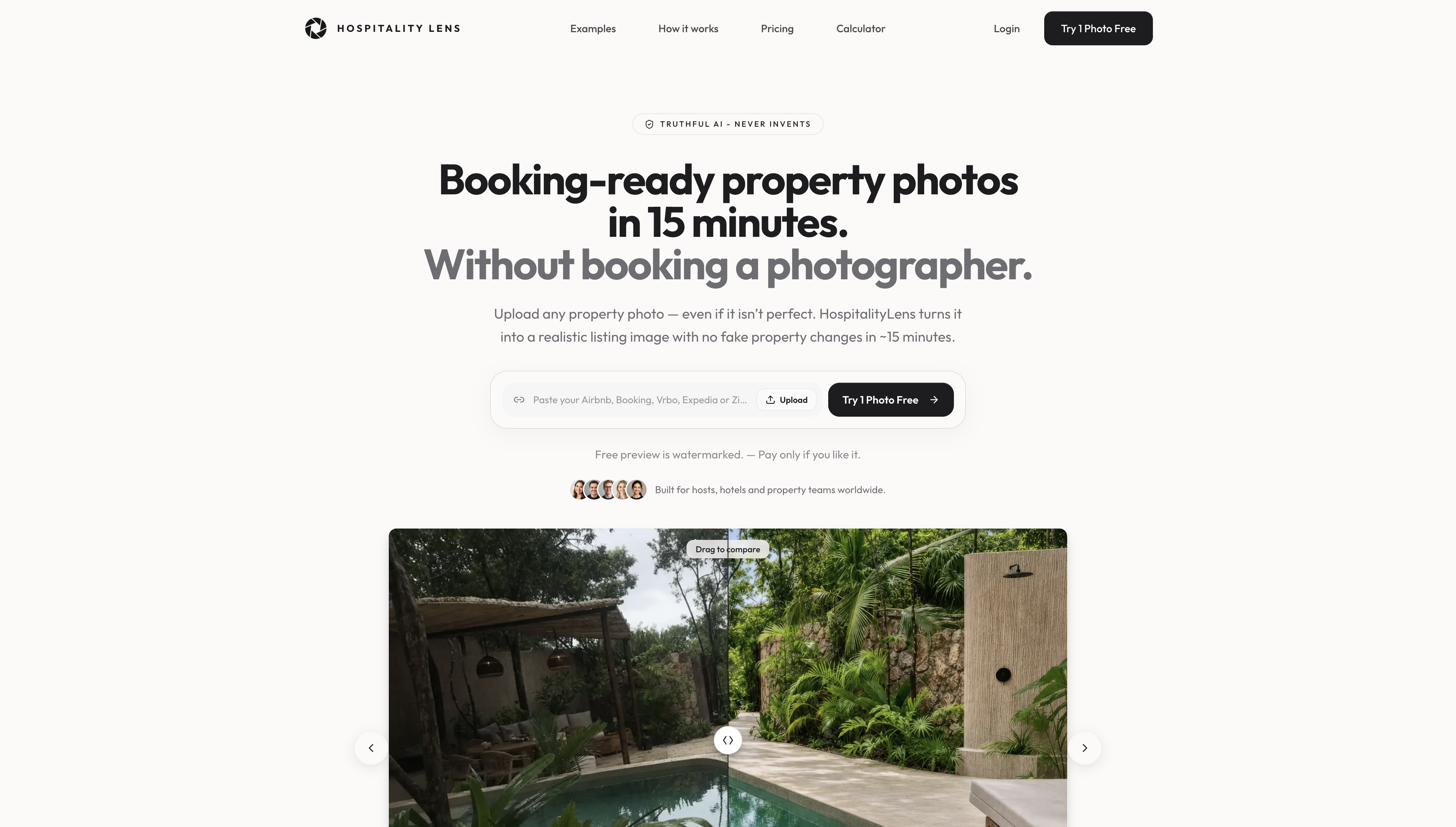
Try one photo free: upload an image and get a watermarked preview at no cost, with no obligation to buy. Pricing details for finished photos, packs, and subscriptions are available on the HospitalityLens website.
Save the flagship shoots, architectural work, and major renovation reveals for a professional photographer instead. For everything else, from routine listing refreshes to new-property onboarding, start your free preview and see how far a truthful edit can take a photo you already have.
Sources
This article is general information, not a substitute for advice from a qualified lawyer. Consult a qualified legal professional about your own circumstances before acting on anything here.
FAQ
Can Images Be Misinterpreted Even When Nothing Was Faked?
Yes. Real, unaltered photos can still mislead through framing, cropping, or the context they’re used in, which is why academic reviews of image perception treat misleading imagery as a broader problem than outright fakery.
What Is the 20-60-20 Rule in Photography?
This isn’t a recognized real estate or photo-ethics standard, and no authoritative source in this space defines it that way, so avoid treating it as a compliance rule for listing images.
Can Someone Sue You for Using Their Pictures?
Image quality can influence how people evaluate a listing, but there is no universal performance uplift that applies to every property. Measure clicks, inquiries, bookings, or sales on the individual listing.
How Can Photos Be Misleading in a Real Estate Listing?
Photos mislead when they change a material fact, like room size, a view, a structural feature, or a defect, in a way a buyer would object to once seeing the property in person; NAR’s Code of Ethics requires listing images to present a “true picture” of current condition.
Does HospitalityLens Fabricate Rooms, Views, or Features?
No. HospitalityLens corrects lighting, color, perspective, and clutter on existing photos and explicitly does not invent rooms, views, or amenities that aren’t in the property, which keeps enhanced images inside the same “true picture” standard the rest of this article describes.
Recommended