Real Estate
Cut Edits to $10–$60: Hybrid Real Estate Photo Editing Cost for Agents
Optimize your real estate listings and save significantly on photo editing costs by leveraging smart hybrid strategies for superior visual impact.
By Hospitality Lens · · 13 min read
Current HospitalityLens pricing (USD); one-time packs — The Hero: 1 photo for $12; The Refresh: 10 photos for $59; The Property: 25 photos for $129; The Portfolio: 100 photos for $399; monthly subscriptions — THE STARTER: 10 photos/month for $49/month; THE OPERATOR: 25 photos/month for $99/month; THE PORTFOLIO: 100 photos/month for $299/month; one-time pack credits do not expire; monthly subscription credits remain valid for up to 3 months; 2 free revisions per photo on one-time packs; 3 free revisions per photo on monthly subscriptions. See current pricing.
TL;DR:
- Basic correction typically costs between $0.20 and $0.50 per image, with AI options matching offshore human pricing but delivering results faster.
- HDR blending ranges from $1.10 to $2.25 per photo, requiring specialized software or skilled editors to balance shadows and highlights effectively.
- Premium retouching, including sky replacement and object removal, can reach $5 to $15 per image for high-end, detailed edits used on cover shots or magazine spreads.
- Image quality can influence how people evaluate a listing, but there is no universal performance uplift that applies to every property. Measure clicks, inquiries, bookings, or sales on the individual listing.
- Combining AI for bulk edits with human refinement on key images offers a cost-effective approach for most property listings.
Table of Contents
What Does Real Estate Photo Editing Cost Per Image?
Vendors rarely publish one flat number, and that’s because photo editing isn’t one service.
Basic correction covers exposure balancing, white balance, and straightening a tilted horizon. This is the cheapest tier because it’s largely automatable, and outsourced human providers commonly charge $0.20 to $0.50 per photo for offshore basic correction with a 24 to 48 hour turnaround, according to a breakdown of outsourcing costs. AI tools land in a similar range, often $0.37 to $0.45 per photo, but return results in minutes rather than a day or two.
HDR blending merges multiple bracketed exposures into one image with balanced shadows and highlights, the look most listing photos aim for today. This tier costs more because it requires either specialized software or a trained editor’s judgment call on how much to pull from each exposure. Managed editing services typically charge $1.10 to $2.25 per photo for this level of work, and general market pricing for real estate editing overall runs $0.45 to $2.50 per image depending on the technique, per Pinnacle Edits’ published pricing.
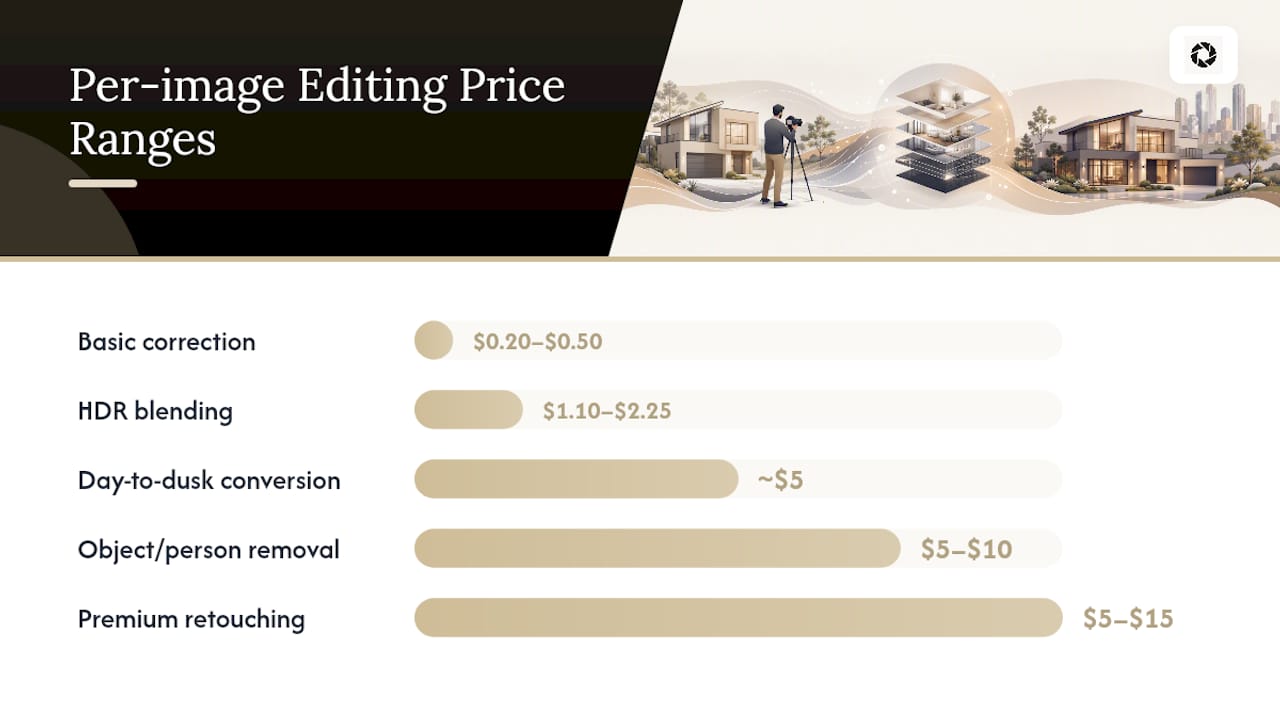
Premium retouching is where the labor cost shows up in the invoice. Manual sky replacement, grass greening, complex object removal, and hand-blended composites for tricky interiors push per-photo pricing to $5 to $15. This tier makes sense for a listing’s cover shot or a magazine spread, not for every photo in a 30-image gallery.
Add-on services get billed separately from base editing almost everywhere; for examples of edited listings that illustrate these techniques, check the Photo Gallery | Real Photos of Our Odessa TX Park | Mesquite Oasis.
- Virtual staging: roughly $20 per image at the low end, up to $79 to $199 per image at some full-service providers, according to PhotoUp’s budget editing roundup
- Image quality can influence how people evaluate a listing, but there is no universal performance uplift that applies to every property. Measure clicks, inquiries, bookings, or sales on the individual listing.
- Object or person removal: typically $5 to $10 per image, scaling with how much needs to be reconstructed behind the removed item
Vendors also differ in how they package these prices. Some sell straight per-image rates, others sell credits redeemable across services, and most offer packs or subscriptions that lower the effective per-photo cost as volume rises. A quote that looks expensive at one photo can look completely different once you’re running 200 images a month through the same pricing tier.
DIY vs Outsourced Editing vs AI: Which Actually Costs Less?
The sticker price on each option tells only part of the story. DIY editing carries no line-item cost, but it has a real cost in hours, and that hour cost rarely gets counted when agents compare their options.
- DIY editing costs $0 in cash but consumes 5 to 15 minutes per photo for someone reasonably competent in Lightroom or Photoshop, more if the shot needs cloning or sky work. For a 25-photo listing, that’s two to six hours of your own time, at whatever your hour is actually worth.
- Outsourced human editors charge $0.20 to $2.25 per photo for standard work, $5 to $15 for premium retouching, with 24 to 48 hour turnaround as the norm and rush tiers of 12 hours or less available for a surcharge, per the outsourcing pricing data.
- AI editing platforms typically run $0.37 to $0.45 per photo on a la carte pricing, dropping further under subscription tiers, and return results in minutes instead of days, according to a comparison of DIY, outsourcing, and AI economics.
The math that matters: if your time is worth $40 an hour and a 25-photo listing takes you three hours to edit yourself, that’s $120 in opportunity cost, more than most outsourced or AI options would charge for the same batch.
Turnaround compounds the cost difference. A rush request on a human-editor workflow, needed because a listing photographer shot on a Friday and the listing goes live Monday, often carries a surcharge on top of the base rate. AI editing sidesteps that problem entirely since the “rush” tier and the standard tier are the same speed.
The workflow that tends to win on both cost and quality is a hybrid one: run the full shoot through AI editing for baseline correction and HDR blending, then send only the four or five hero images (the cover photo, the kitchen, the primary bedroom) to a human editor for finishing work. You get bulk savings on quantity and get to spend your retouching budget where it actually shows up in click-through, the listing thumbnail and the first two or three photos.
What Drives the Price on Every Editing Quote?
Two quotes for the same 25-photo listing can differ by a factor of five, and the gap usually comes down to eight variables vendors don’t always spell out upfront.
- Capture type: a single exposure edits faster and cheaper than bracketed HDR (three to five exposures blended into one), and panoramas or 360-degree shots cost more still because they need stitching before any correction begins.
- Turnaround demanded: standard 24 to 48 hour delivery is the baseline rate; same-day or overnight rush requests commonly add a surcharge, especially on weekends when staffing thins out.
- Volume committed: per-photo cost drops meaningfully once you commit to a pack or monthly subscription instead of paying one-off rates.
- Revision allowance: some vendors bundle two or three revisions per photo into the base price, others charge for every re-edit, which changes the real cost if your first pass isn’t right.
- Add-on services: virtual staging, day-to-dusk conversion, and object removal are billed separately almost everywhere, so a “cheap” base rate can hide a much higher final invoice.
- Licensing and usage rights: confirm whether the price includes full commercial usage or just listing use, since marketing and print use sometimes carry a separate license fee.
- Geography of the editing team: offshore teams tend to price at the low end of every tier; domestic or in-house editors price higher but may offer faster same-timezone communication.
- Aerial or drone-sourced images: these typically need separate handling for perspective and lens distortion, which some vendors price as a distinct line item.
Pro Tip: Ask every vendor the same direct question before comparing quotes: “How many revisions are included per photo, and what’s the rush fee if I need 48-hour turnaround in 24 hours?” That single question exposes more real cost difference than the base per-photo rate ever will.
How Much Should a 25-Photo Listing Actually Cost?
Run the numbers on a standard 25-photo listing gallery at three price points, and the spread gets clearer fast.
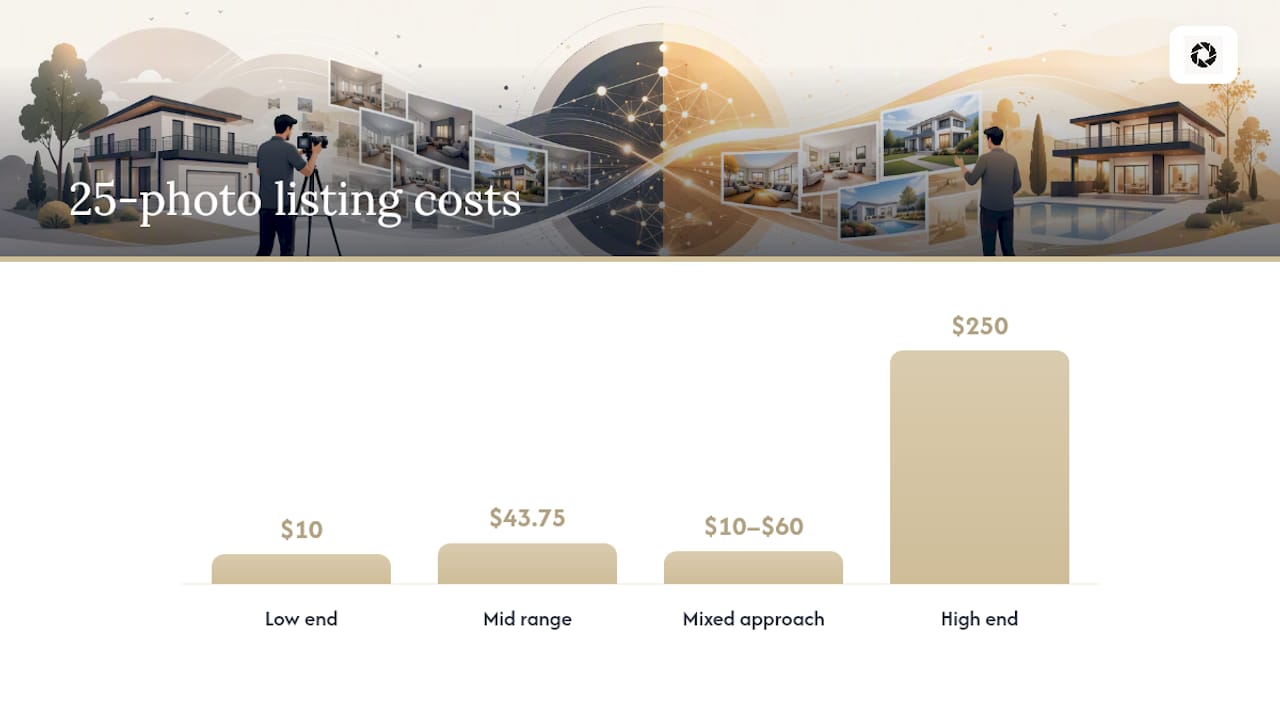
- Low end (basic correction, AI or offshore): 25 photos × $0.40 average = $10 for the full gallery
- Mid range (HDR blend, managed service): 25 photos × $1.75 average = $43.75 for the full gallery
- High end (premium retouch on every image): 25 photos × $10 average = $250 for the full gallery
Most listings don’t need every photo at the high end. Photography and related service costs vary by market, property size, scope, deliverables, licensing, travel, and provider. Compare current quotes rather than relying on a universal market average.
Monthly volume changes the calculation entirely. A property manager running 200 images a month across ten listings pays roughly $80 to $90 through an AI subscription tier, versus $220 to $450 through a mid-tier outsourced human service, and well over $1,000 if every image gets premium retouching. The DIY option costs nothing in cash but consumes 15 to 50 hours of staff time a month, hours that could otherwise go toward guest communication or new listing acquisition.
Breakeven math is the part most agents skip. Image quality can influence how people evaluate a listing, but there is no universal performance uplift that applies to every property. Measure clicks, inquiries, bookings, or sales on the individual listing. Stronger listing presentation can support commercial performance, but revenue and ROI depend on the property, market, pricing, demand, channel mix, and conversion funnel. Measure the result on your own listings rather than assuming a universal uplift.
How HospitalityLens Fits Into This Pricing Picture
HospitalityLens sits in the AI tier of this pricing landscape, built specifically for property managers and hosts who already have usable photos and need them booking-ready without arranging a new shoot. It handles lighting and color correction, perspective and horizon straightening, clutter cleanup, and people or object removal. It does not add staging, invent rooms, or alter architectural features, since the goal is a truthful upgrade of the property you actually have.
Pricing follows the same logic outlined above, structured for teams managing more than one listing:
Current HospitalityLens pricing (USD); one-time packs — The Hero: 1 photo for $12; The Refresh: 10 photos for $59; The Property: 25 photos for $129; The Portfolio: 100 photos for $399; monthly subscriptions — THE STARTER: 10 photos/month for $49/month; THE OPERATOR: 25 photos/month for $99/month; THE PORTFOLIO: 100 photos/month for $299/month; one-time pack credits do not expire; monthly subscription credits remain valid for up to 3 months; 2 free revisions per photo on one-time packs; 3 free revisions per photo on monthly subscriptions. See current pricing.
A professional photographer still beats any AI or outsourced editing service for flagship launches, architectural photography, drone or aerial capture, and situations where the existing photos are unusable at any price. HospitalityLens works best on the listing refresh and onboarding side of the business, not as a replacement for capturing new angles a camera never took.
Editor Perspective: The Right Approach Depends on What You’re Actually Buying
Most pricing guides treat every buyer the same, and that’s the mistake. A single agent listing one property has completely different math than a property manager running forty units, and treating both the same way wastes money in opposite directions.
If you’re an agent handling occasional listings, try AI editing first and reserve human retouching for hero shots only. Don’t subscribe to anything until you’ve run the numbers on three or four listings.
If you manage a portfolio, a pack or subscription plus a human pass on your top five images per listing is the sustainable model. Test it on one photo before committing to volume.
If you’re a photographer, your time is worth more shooting than editing. Outsourcing or hybrid editing frees you to book more shoots instead of sitting in Lightroom past midnight.
— The HospitalityLens Team
Try One Photo Free Before You Commit to Anything
Free watermarked preview. Pay only if you like it. No card is required to create the free watermarked preview. See current pricing for unlocks, one-time packs, and subscriptions.
Current HospitalityLens pricing (USD); one-time packs — The Hero: 1 photo for $12; The Refresh: 10 photos for $59; The Property: 25 photos for $129; The Portfolio: 100 photos for $399; monthly subscriptions — THE STARTER: 10 photos/month for $49/month; THE OPERATOR: 25 photos/month for $99/month; THE PORTFOLIO: 100 photos/month for $299/month; one-time pack credits do not expire; monthly subscription credits remain valid for up to 3 months; 2 free revisions per photo on one-time packs; 3 free revisions per photo on monthly subscriptions. See current pricing.
Sources
FAQ
Is There a Free Way to Edit Real Estate Photos?
Free mobile apps and Lightroom presets handle basic correction at no cash cost, though they take real time per photo. HospitalityLens also offers one free watermarked preview edit before any purchase is required.
Is It Legal to Edit Real Estate Photos?
Standard corrections like exposure, color, and perspective fixing are legal and standard practice, but adding features that don’t exist, like a pool or a view, or removing defects that affect habitability, can create legal and disclosure problems. Truthful enhancement of what’s actually in the photo is the safe line to stay on.
What Do Realtors Use to Edit Photos?
Realtors commonly use Adobe Lightroom and Photoshop for DIY work, outsourced editing services for bulk HDR blending and retouching, and increasingly AI-based platforms like HospitalityLens for fast, low-cost correction on existing listing photos.
How Much Should I Charge for Editing Photos?
Rates typically track the tiers covered above: $0.20 to $0.60 for basic correction, $0.60 to $2.50 for HDR blending, and $5 to $15 for premium retouching, with pricing scaled by volume, turnaround demanded, and revision allowances included.
Recommended