Real Estate
Agents: Repurpose Photos Into 4 Formats, Try a $59 AI Fix
Transform your existing listing photos into diverse marketing formats and enhance them with AI to boost appeal without costly reshoots.
By Hospitality Lens · · 13 min read

Yes, you can usually repurpose listing photos, but only after you confirm reuse rights and run a quick quality check. The highest-value moves are turning one photo set into a multi-variant listing video, cutting vertical clips for social, and preparing unbranded assets for MLS or seller sharing. If the photos are usable but tired, an enhancement pass through an AI photo enhancement service can get them booking-ready faster than scheduling a new shoot.
TL;DR:
- Reusing listing photos requires confirming copyright and license rights, especially when sourcing images from previous listings or other agents.
- Creating multiple format versions from one well-shot set, including social media reels and print flyers, maximizes marketing channels without reshoots.
- AI photo enhancement offers a quick, cost-effective way to improve lighting and clutter issues on existing images, reducing the need for redeployment of professional shoots.
- When photos are too low resolution, missing key features, or significantly distorted, a professional reshoot remains the only ethical and effective solution.
- Disclosing any digitally altered images is often required by MLS policies, with fines possible for undisclosed edits, making transparency essential.
HospitalityLens
Refresh Listing Photos Without Reshooting
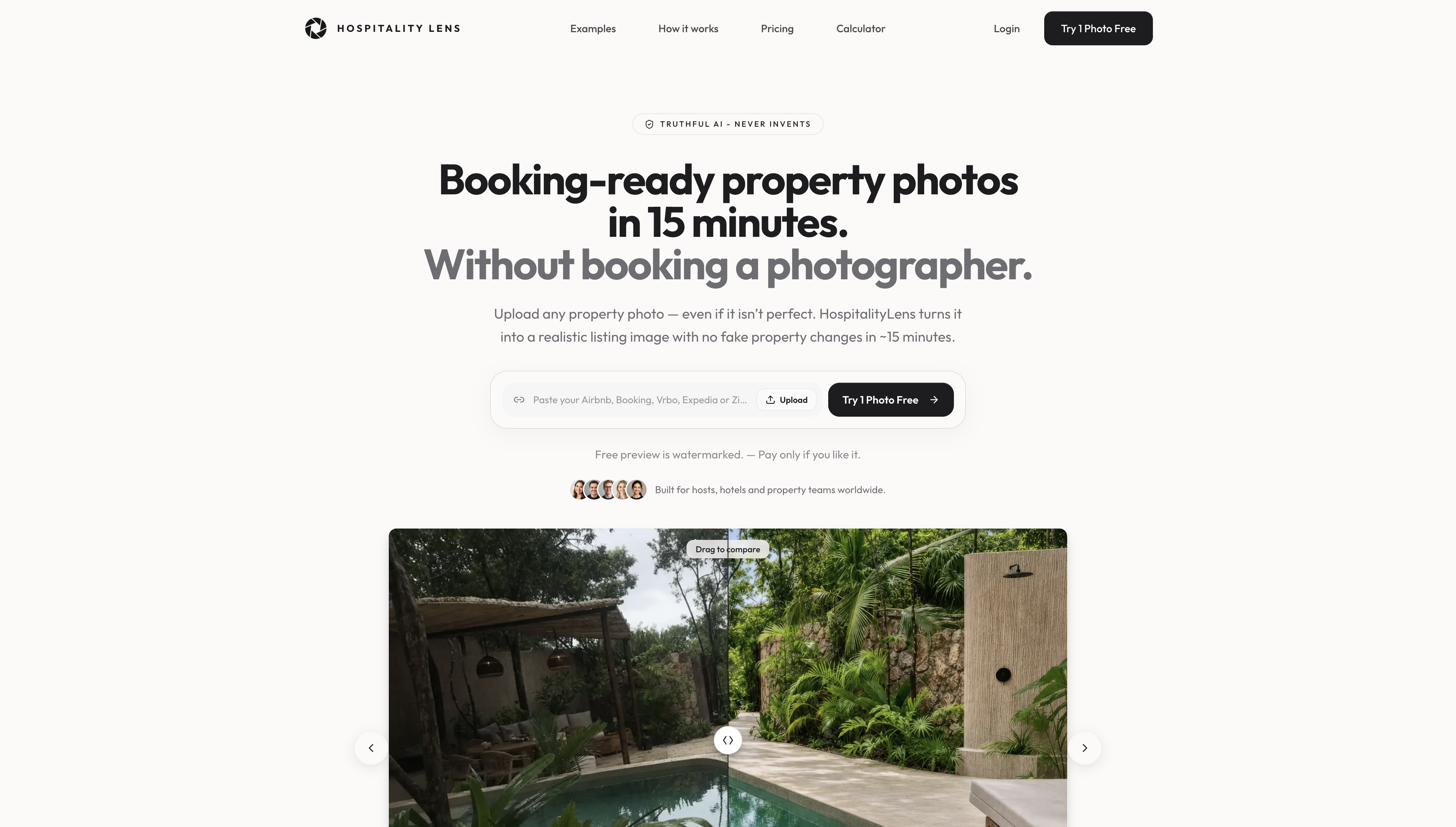
Turn usable phone or existing listing photos into realistic, booking-ready images with lighting, perspective, clutter, and color improvements.
Try one photoTable of Contents
High-impact repurposing tactics for one listing’s photos
A single, well-shot listing already contains most of the marketing you need. The work is not producing more images, it is shaping the ones you have into formats that fit where your buyers and renters actually look.
Start with what you might call the source asset: one clean set of images that becomes the base for everything else. From there, most agents and property teams find four core outputs cover nearly every channel.
- A horizontal branded version, with your logo and contact details, for your website and paid ads.
- A horizontal unbranded version for MLS syndication and cooperating agents.
- A vertical branded version for Instagram Stories, Reels, and TikTok.
- A vertical unbranded version for partners, referral agents, or co-marketing.
Once those four exist, short-form video is the next logical stop. A hook clip built around the best room, a slow reveal of the kitchen or the view, a “guess the price” format that plays on curiosity, or a short neighborhood context clip using exterior and street shots all pull from photos you already have. According to Reel-E’s breakdown of listing content, one listing processed this way can yield ten or more distinct pieces of video content from a single source asset, and the same source cites NAR data showing listings with video receive substantially more inquiries than those without.
Image-based formats matter just as much, especially for audiences who scroll rather than watch. Carousels that walk a viewer room by room, before-and-after edits that show a quick clean-up or lighting correction, PDF flyers for open houses, and printed leave-behinds all reuse the same underlying files with different crops and layouts. None of this requires a new lens on the property, just a clear sense of what each format is for.
There is a further step some agents skip: treating a strong photo set as something you can sell, not just publish, with guidance from Real Connected – Marketing & Design Experts on adapting property photography across channels. A short cinematic renovation teaser built from before-and-after images, or a paid listing video package offered to sellers as an add-on, turns a repurposing exercise into a small revenue line. One caution here: recent workflows built around AI-generated sunset skies or renovation previews can look impressive, but they risk misrepresenting the property if they alter permanent features rather than simply improving lighting or removing clutter, a distinction Swipefile’s overview of AI renovation videos flags directly.
Pro Tip: Build your four core formats before you touch video. Every clip, carousel, and flyer gets easier when the source images are already cropped and cleaned for both orientations.
Turning photos into videos, reels, and enhanced images
Repurposing works best when it is a process, not a scramble every time a new listing lands. Two workflows cover most of what agents and marketers need, one for producing video and social content, one for enhancing the underlying images.
The photo-to-video workflow follows a simple sequence: write a short prompt or outline describing the story you want the clip to tell (arrival, hero room, reveal, exterior), generate two or three variant cuts from your source images, then export in your four target formats. Reel-E documents a repeatable version of this that a single marketer can run in 45 to 60 minutes and used to schedule roughly two weeks of posts from one listing.

A single listing with video can generate ten or more content pieces from one source asset, according to Reel-E’s workflow breakdown, which means the time spent on the first export pays off across every channel you post to afterward.
The photo enhancement workflow is shorter and runs in parallel:
- Audit the existing set for lighting, angle, and clutter issues before deciding what needs fixing.
- Send flagged photos through an AI enhancement tool or a manual editor, depending on volume and budget.
- Review the preview against the original to confirm nothing beyond lighting, color, and perspective has changed.
- Request revisions on anything that still reads as dark, crooked, or cluttered before publishing.
Export settings depend on where the image lands. MLS platforms typically want high-resolution, unbranded horizontal files. Social platforms want vertical crops sized for full-screen viewing. Email newsletters and print flyers usually need a middle ground, moderate resolution, branded, and readable at a smaller size. Keeping a simple naming convention for each version prevents the wrong file from ending up in the wrong place.
Staffing depends on volume. A single agent managing one or two listings a month can run both workflows solo inside an hour. Teams managing a full portfolio, or property managers refreshing dozens of units on a seasonal basis, tend to delegate enhancement to a service and keep video and social work in-house, since enhancement is the more repetitive, quality-sensitive step.
Verifying your reuse rights and MLS rules
Before any photo gets reused, the question that matters most is not “does this look good” but “do I have the right to use it here.” Copyright in a photograph exists the moment it is taken, whether or not anyone registers it, and the photographer typically holds that copyright unless a contract says otherwise. The U.S. Copyright Office’s guidance for photographers confirms this and recommends registration because it creates a public record and opens up certain legal remedies the photographer would not otherwise have.
Real estate photo rights get complicated fast because so many parties touch one listing. NAR’s guidance on who owns property photos points out that authorship is often fractured between the photographer, the brokerage, and sometimes a franchise or MLS system, and that reusing images without checking the original license can create real legal exposure. NAR recommends reviewing your photography agreements and keeping a written record of what you are permitted to do with each set of images.
MLS systems add another layer. Some MLS platforms require disclosure whenever an image has been digitally altered. ARMLS’s policy on digitally altered media is a concrete example: it requires disclosure and cites a $200 fine for listings that fail to flag altered images.
A short audit checklist keeps this manageable:
- Pull the original photography contract or license agreement for the listing.
- Confirm in writing who owns the images and what reuse rights you were granted.
- Ask for explicit permission before reusing photos from a previous listing or a different agent’s shoot.
- Keep a dated record of every permission granted, even an email, in case a dispute comes up later.
| Rule source |
What it requires |
| U.S. Copyright Office |
Copyright exists at the moment a photo is fixed; registration adds legal remedies. |
| NAR |
Review licensing terms; authorship is often shared across photographer, brokerage, and MLS. |
| ARMLS |
Digitally altered media must be disclosed; failure to disclose can draw a $200 fine. |
A repeatable audit for deciding what to keep
Most photo libraries have more usable material than agents assume, once they are sorted properly. A three-folder system works well: ready now for photos that need nothing more than a crop or export, fixable for photos with a lighting, angle, or clutter problem an edit can solve, and discard for anything the property no longer matches or that is too low quality to save.
- Sort every photo into one of the three folders before editing anything.
- Flag “fixable” images by specific issue: dark exposure, crooked horizon, visible clutter, or an object that needs removing.
- Discard anything under about two years old that still shows outdated staging or a room that has since changed, and anything heavily filtered in a way that no longer matches the property’s current condition.
- Rename files with a consistent structure, property name, room, and version number, so nothing gets mixed up across shoots.
Quick edits like brightening a dim room, straightening a horizon, or clearing a stray object are generally safe. Edits that change a permanent feature, such as a view, a fixture, or the layout of a room, cross into territory that needs disclosure under most MLS policies and risks misrepresenting the property outright.
Pro Tip: Keep a simple version log alongside your files, noting what was changed and when. It takes thirty seconds and saves a headache if a buyer or an MLS compliance reviewer ever asks.
Every channel has its own expectations, and getting the format wrong is one of the most common reasons repurposed photos underperform or get flagged.
- MLS listings generally want unbranded, high-resolution horizontal images, often with a file size cap, and any digitally altered photo should be disclosed per your local MLS policy.
- Social platforms favor native vertical crops, a caption written as a hook rather than a description, both branded and unbranded variants depending on whether you are posting as an agent or sharing with a partner, and a posting cadence spread over roughly ten to fourteen days rather than dumped all at once.
- OTAs and booking sites expect a specific sequence, usually exterior first, then the main living space, then bedrooms and bathrooms, and they require that every image truthfully represent the space as it exists today.
- Email and print need moderate resolution files with the property address, price, and a clear call to action included directly on the asset, since these formats are rarely clicked through to a source page.
When a reshoot beats editing
Editing has limits. If a photo is too low resolution to enlarge, distorted beyond a simple perspective correction, or missing a room entirely, no workflow fixes that, a reshoot is the only real option.
There are ethical limits too. Any edit that misrepresents a property’s condition or removes a permanent feature belongs nowhere near a live listing, regardless of how good it looks.
Strategic limits matter as well. Flagship launches, luxury listings, and properties anchoring a larger marketing campaign usually justify the cost of a dedicated shoot, since the goal there is new angles and a fresh narrative, not a faster version of what already exists.

Where AI enhancement fits next to photography
Responsible AI enhancement earns its place when speed and volume matter most: refreshing a seasonal listing, onboarding a new property fast, or cleaning up owner-submitted photos that are usable but rough. A photographer still wins when a listing needs new angles, architectural emphasis, or a shoot built around features no existing photo captures. The strongest teams treat these as complementary tools, not a choice between one and the other.
— The HospitalityLens Team
Trying HospitalityLens for your next photo refresh
If your photos are usable but need work, enhancing them costs less time and money than rebooking a shoot, especially across a portfolio where every listing needs the same lighting and clutter fixes. Some AI photo enhancement services let you try one photo free, with a watermarked preview and no obligation to buy.
Current HospitalityLens pricing (USD); one-time packs — The Hero: 1 photo for $12; The Refresh: 10 photos for $59; The Property: 25 photos for $129; The Portfolio: 100 photos for $399; monthly subscriptions — THE STARTER: 10 photos/month for $49/month; THE OPERATOR: 25 photos/month for $99/month; THE PORTFOLIO: 100 photos/month for $299/month; one-time pack credits do not expire; monthly subscription credits remain valid for up to 3 months; 2 free revisions per photo on one-time packs; 3 free revisions per photo on monthly subscriptions. See current pricing.
- Start with a single photo to see the quality before committing to a pack.
- Compare enhancement against a new shoot using the HospitalityLens enhancement comparison page.
- Read the full process on the step-by-step guide before uploading your first image.
Try one photo free and see whether enhancement gets your listing back to booking-ready without a new shoot.
Sources
FAQ
Can you use photos from a previous listing?
Only if you have documented permission from whoever holds the copyright, usually the original photographer or the brokerage that commissioned the shoot. NAR’s guidance recommends checking the original licensing agreement before reusing any image tied to a past listing.
What are some creative ways to use old listing photos?
Beyond the original listing, old photos can become social carousels, short video hooks, before-and-after comparisons, or printed flyers for open houses. Pairing them with a light enhancement pass often makes an older photo set usable again without a new shoot.
What to do with a large backlog of old property photos?
Sort them into three groups: ready to use as is, fixable with a quick edit, and outdated enough to discard. From there, prioritize enhancing the fixable group first since it usually offers the fastest return for the least effort.
Do I need to disclose AI-enhanced listing photos?
Some MLS systems require it. ARMLS’s policy, for example, requires disclosure of digitally altered media and can fine undisclosed edits $200, so check your local MLS rules before publishing enhanced images.
Is AI photo enhancement a real substitute for a professional photographer?
For usable but rough photos, tools like HospitalityLens can restore lighting, correct perspective, and clean up clutter without a new shoot. For flagship listings, new angles, or architectural detail, a professional photographer remains the better choice.
Recommended