Real Estate
Visual Appeal in Rental Listings: What It Really Means
High-quality visuals in rental listings are crucial, attracting more potential tenants, building trust, and speeding up the leasing process significantly.
By Hospitality Lens · · 9 min read

Visual appeal in rental listings is the combined effect of photography quality, image coverage, sequence, and design consistency that shapes a renter’s first impression online. Rental-industry surveys repeatedly show that prospective renters use interior photos to evaluate properties, but the exact importance varies by survey and market. The practical goal is a clear, current gallery that answers the renter’s questions before a viewing or booking inquiry.
What is visual appeal in rental listings, and why does it matter?
Visual appeal in rental listings is the industry term for listing aesthetics, which refers to the deliberate use of photography, image sequencing, layout, and design to communicate property quality at a glance. The standard industry concept behind this is visual communication design, applied specifically to property marketing. When done well, it answers a renter’s core questions before they even read the description.
The stakes are high. Visuals act as gatekeepers for listing engagement, and first impressions are formed before a renter consciously processes any detail. A blurry photo of a living room signals neglect, even if the apartment is spotless. A well-lit, clearly composed shot of the same room signals care and professionalism.
Renters do not browse listings the way they read articles. They scan thumbnails, click on what catches their eye, and scroll photos before reading a single word of copy. That behavior pattern means the importance of visual appeal is not just aesthetic. It is functional. Your photos either open the door to a conversation or close it permanently.
How does visual appeal affect renter psychology?
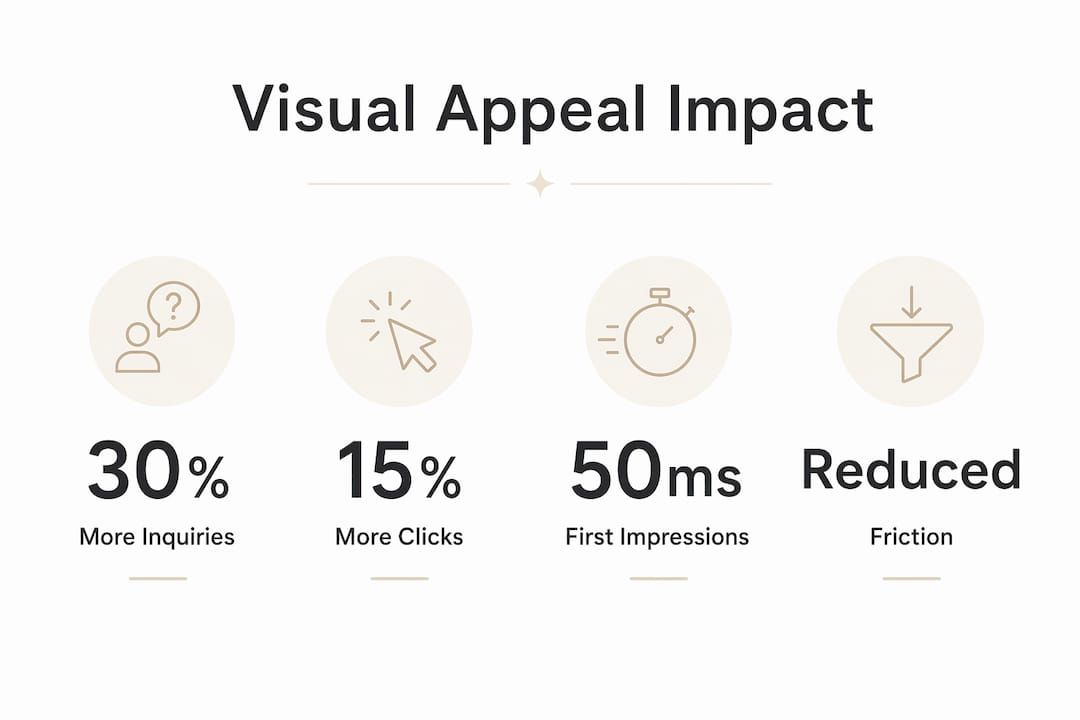
Visual impressions form within 50 milliseconds, and that snap judgment shapes everything that follows. This is the Aesthetic-Usability Effect in practice: renters perceive visually appealing listings as more trustworthy, better maintained, and worth a higher rent, even before they verify a single fact.
“Visual appeal evokes feelings of safety and homeyness that encourage tenant action.” — Property management research consistently shows that emotional cues embedded in photos drive inquiry rates more than written descriptions alone.
The psychology runs deeper than aesthetics. A well-lit kitchen photo does not just show a kitchen. It signals that the property owner is attentive. A dark, cluttered photo signals the opposite, regardless of the actual condition of the space. Renters make these inferences automatically and act on them.
Consistent visual design acts as a quality signal that reduces cognitive load for renters choosing between properties. When a listing flows logically from room to room with consistent lighting and framing, renters feel oriented and confident. When photos are inconsistent or randomly ordered, renters feel uncertain and move on.

Pro Tip: Stage each room to communicate one clear purpose. A bedroom should look like a bedroom, not a storage room with a bed in it. Renters mentally move into a space when photos are clear and purposeful.
Which visual elements most affect rental listing attractiveness?
The most impactful visual elements in rental ads are not expensive to get right. They require attention to detail, not a large budget. Here is what actually moves the needle:
-
Interior photo quality. Sharp, well-lit photos of the major rooms make the property easier to evaluate and reduce uncertainty about layout and condition.
-
Photo count and coverage. Including 15–20 photos covering all practical areas answers tenant questions upfront and reduces friction inquiries significantly.
-
Practical area coverage. Showing utilities, parking, laundry, and common areas removes uncertainty. Renters who cannot see these areas ask about them, which slows your conversion.
-
Listing layout. Balancing photos with scannable text, bullet-point amenities, and clear headings creates a listing that is easy to process quickly.
-
Authentic representation. Over-edited photos that make a small room look like a ballroom destroy trust the moment a renter visits in person.
The table below compares two common listing approaches by their visual impact:
| Visual approach |
Renter experience |
Inquiry outcome |
| 5 dark, low-resolution photos |
Uncertainty, low trust |
Few or no inquiries |
| 15–20 bright, sequenced photos covering all rooms and amenities |
Confidence, high trust |
Significantly more inquiries |
| Over-edited, staged-only photos |
Initial interest, then distrust at viewing |
High no-show rate |
| Honest, well-lit photos with practical area coverage |
Consistent trust before and after viewing |
Lower no-shows, faster lease signing |
The pattern is clear. Honest, thorough photo coverage outperforms both minimal coverage and over-produced staging. Renters reward authenticity with action.
How can property owners enhance listing photos effectively?
Improving the visual appeal of your rental listing does not require hiring a professional photographer every time you update your listing. It does require a consistent process.
-
Shoot in natural light. Open every blind and curtain before photographing. Natural light makes spaces look larger and cleaner than any artificial lighting setup.
-
Shoot from corners. Photographing from a corner of the room captures the most space and gives renters a sense of the full layout.
-
Sequence photos like a walkthrough. Start at the front door, move through living areas, then kitchen, then bedrooms, then bathrooms, then practical spaces. Photo walkthrough sequences improve tenant conversion and reduce cancellations by building familiarity before the visit.
-
Add a floor plan. Floor plans complement photos by giving renters spatial context that photos alone cannot provide. Renters who understand the layout before visiting are more committed when they arrive.
-
Update photos seasonally. A listing photographed in winter with bare trees and gray light performs worse in spring than one updated with current, bright imagery.
-
Use AI photo enhancement for existing photos. Tools like Hospitalitylens can take any existing photo, regardless of quality, and produce a professional-grade result in 15 minutes without altering the property itself.
Pro Tip: Never photograph a room with the toilet lid up, dishes in the sink, or personal items visible. These details read as carelessness and cost you inquiries from renters who would otherwise be a perfect fit.
Maintaining consistency across all photos matters as much as the quality of individual shots. A listing where some photos are bright and professional and others are dark and blurry signals inconsistency, which renters interpret as a sign of inconsistent property management.
What measurable impact does visual appeal have on bookings?
Photos, amenity information, price, availability, location, reviews, and the written listing work together. Published surveys and user-behavior research support the practical importance of clear imagery, but they do not provide one universal percentage by which better photos will increase clicks, inquiries, occupancy, or revenue for every rental.
Measure the effect on your own listing. Record the metrics your platform exposes before the change, update the gallery without simultaneously changing every other variable, and compare a representative period afterward. Treat the result as evidence for that property rather than a market-wide benchmark.
Strong visuals can also reduce uncertainty by answering practical questions before an inquiry: room layout, condition, kitchen setup, parking, outdoor areas, bathrooms, and other material features. That is useful even when the impact cannot be expressed as a guaranteed conversion percentage.
Key Takeaways
| Point | Practical implication |
|---|
| Photos shape first impressions | Lead with a clear, representative image that remains readable at thumbnail size. |
| Interior coverage matters | Show the spaces a renter needs to evaluate rather than relying on decorative detail shots alone. |
| Structure reduces uncertainty | Sequence the gallery logically and pair images with accurate amenity and property information. |
| Honest coverage beats exaggeration | Show the real layout, condition, permanent features, and material limitations of the property. |
| Performance is listing-specific | Measure your own clicks, inquiries, and bookings instead of assuming a universal uplift. |
A practical standard for rental-listing visuals
The useful distinction is not “professional” versus “perfect.” It is whether the gallery is clear, current, complete, and faithful to the property. A phone photo can be useful when it is sharp and well framed; an expensive image can still fail if it hides important information or no longer matches the unit.
Build the gallery like a walkthrough. Start with a strong representative image, cover every important room and amenity, remove near-duplicates, and include practical spaces when they matter to the renter. The goal is to reduce uncertainty before the inquiry, not to manufacture a more luxurious property than the one being offered.
Refresh images when the property changes or when the existing gallery materially misrepresents its current condition. There is no evidence-based rule that every rental needs a complete annual reshoot; update on the cadence the property actually requires.
Better listing photos are closer than you think
Most property owners know their photos could be better. The barrier is usually time, cost, or not knowing where to start.
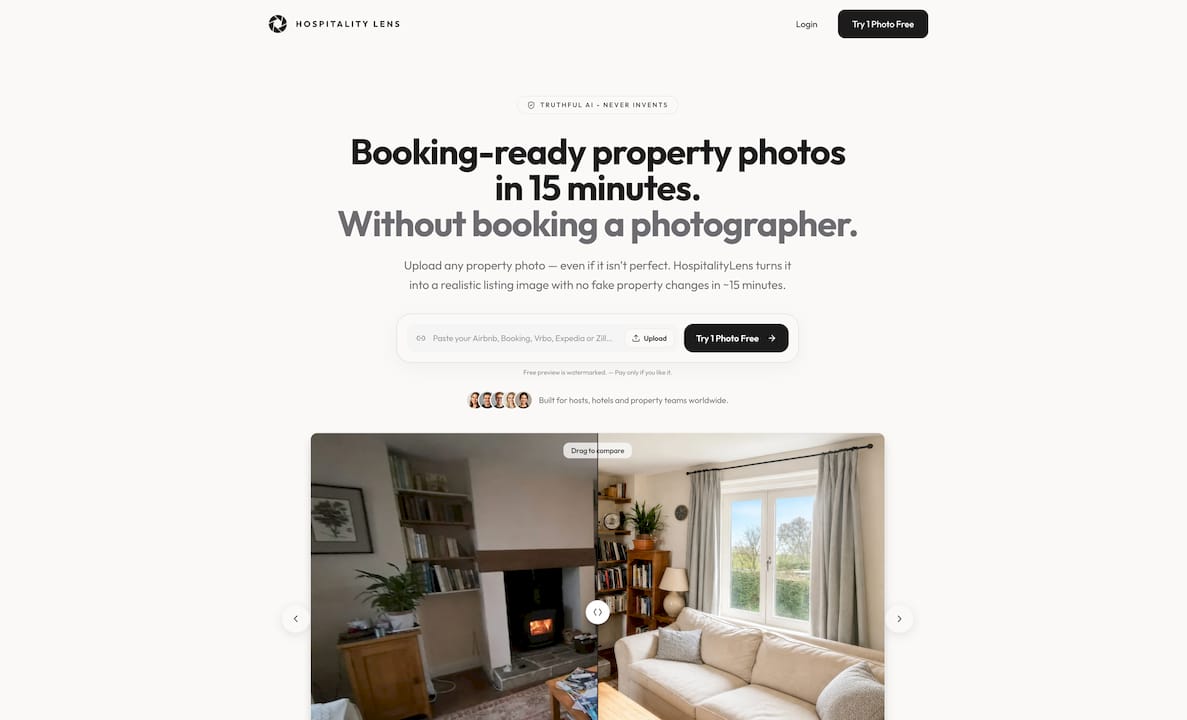
Free watermarked preview. Pay only if you like it. No card is required to create the free watermarked preview. See current pricing for unlocks, one-time packs, and subscriptions.
FAQ
What is visual appeal in a rental listing?
It is the combined effect of photo quality, coverage, sequencing, and presentation that helps a renter understand the property quickly and accurately.
How much can professional photos increase rental inquiries?
There is no universal inquiry uplift. Clear photos and accurate amenity information can make a rental easier to evaluate, but the effect should be measured using the property’s own listing and channel data.
What attracts renters visually in a listing?
Sharp, well-lit images, complete room coverage, a clear lead image, realistic colors, and an easy-to-follow gallery help renters understand what is being offered without exaggerating the property.
How many photos should a rental listing have?
Use enough photos to cover every material room, amenity, exterior area, and practical feature without padding the gallery with near-duplicates. The right count depends on the property and the current platform guidance.
Can AI improve rental listing photos without misleading renters?
Yes, when the work improves presentation while preserving the actual layout, permanent features, amenities, condition, and view. Any edit that materially changes what the renter should expect crosses the line into misleading presentation.
Recommended
Article generated by BabyLoveGrowth