Short-Term Rentals
Real Estate Photo ROI Factors for Short-Term Rentals
Discover how high-quality listing photos significantly boost bookings and revenue for your short-term rental properties, ensuring a rapid return on your investment.
By Hospitality Lens · · 14 min read

TL;DR:
- High-quality photos that showcase bright, wide-angle views of key spaces significantly improve short-term rental bookings. Testing and matching media spend to property tier ensures better engagement, higher visibility, and faster sales, with ROI often achieved in under one booking. Honest, optimized images across all channels build trust, reduce vacancies, and support sustainable revenue growth.
The photo factors that move short-term rental bookings most are a bright, wide-angle hero shot of the primary living space, a clean exterior, accurate twilight or drone context where the property warrants it, and truthful virtual staging for vacant units. Guests and buyers commonly evaluate properties online before taking the next step, making the gallery an important part of the decision surface. Listings with professional photography can generate significantly more online views and sell notably faster than comparable listings with weaker images.
Quick priorities:
- Fix the hero shot first. A dark, crooked, or cluttered lead image kills CTR before any other factor.
- Sequence matters. The thumbnail drives the click; the interior sequence closes the booking.
- Match media spend to listing tier. Bread-and-butter units need bright, honest photos. High-ADR properties need cinematic media to justify premium rates.
- Test before scaling. Run a 4-week comparison on one listing before refreshing the whole portfolio.
- HospitalityLens offers a single free photo trial so you can measure the impact before committing.
Table of Contents
Which photo improvements directly increase CTR, views, saves, and bookings
Photo quality is not just aesthetic. It feeds platform algorithms. Booking platforms rank listings partly on engagement signals: click-through rate, save rate, and booking velocity. Better images raise all three, which compounds over time as the algorithm rewards higher-engagement listings with more visibility.
The shot list that consistently moves metrics:
- Hero exterior or primary living area (lead thumbnail): bright, wide, horizon-level
- Kitchen: clean counters, natural or corrected light, no clutter
- Primary bedroom: wide angle, made bed, no personal items
- Bathroom: bright, clean, no toiletries on the counter
- Unique amenity: pool, view, fireplace, workspace
- Neighborhood or drone context: especially for properties with land, water, or architectural distinction
- Twilight exterior: high-ADR properties only; adds perceived luxury
Sequencing matters as much as shot quality. Photo sequencing strategy research shows that leading with a lifestyle-oriented hero, then moving through the property in a logical walk-through order, reduces bounce and increases saves. For platforms like Airbnb and Vrbo, the thumbnail is the ad; the gallery is the close.
Pro Tip: Avoid over-stylized images. Research on imagery and consumer trust shows that images perceived as “too perfect” trigger skepticism. A mix of wide holistic shots and honest functional details builds more trust than a polished set that looks staged beyond recognition.
The useful formula is straightforward: ROI = (measured incremental revenue − photo cost) / photo cost. The difficult part is not the arithmetic; it is establishing whether the photo change actually caused the performance change.
Build a baseline from your own property data: ADR, occupancy, listing views, click-through or engagement metrics the platform exposes, and booking volume. Compare a similar period after the image change while noting price changes, availability, seasonality, promotions, local events, and other variables that can distort attribution.
Do not insert a generic 5%, 10%, or 15% occupancy uplift into the calculator and call the result a forecast. Those percentages are assumptions unless they come from your own controlled historical data. A useful scenario model labels every assumed input clearly and then replaces assumptions with observed data as it becomes available.
Example calculation structure: if your own test shows incremental revenue of R after controlling for other material changes, and the image work cost C, the measured ROI is (R − C) / C. If you cannot isolate R with reasonable confidence, report the result as inconclusive rather than assigning a percentage return.
Do not assume a universal uplift benchmark
There is no defensible universal CTR, occupancy, ADR, booking, or revenue uplift that every short-term rental should expect from better photos. Property type, market, price, season, existing image quality, platform mix, and the rest of the listing all affect the outcome.
Use external studies to understand why imagery matters, then use your own listing data to quantify the business case. For a portfolio, prioritize the properties where the current images are visibly weak, the source photos are still accurate, and the commercial value of a clearer presentation is high enough to justify the work.
How to prioritize photo spend across your portfolio
Prioritize by the gap in the current gallery and the capture work actually required. A usable but poorly lit source image may only need enhancement; a renovated room, missing amenity, weak composition, or outdated gallery needs new capture. High-value or flagship properties may justify specialized photography, drone, twilight, styling, floor plans, or video when those deliverables materially help explain the property.
For every tier, record the actual cost and measure the result against that property’s baseline instead of assigning an expected percentage uplift in advance.
Cost options: DIY, pro shoots, virtual staging, and AI enhancement
Costs vary substantially by city, property size, image count, licensing, travel, drone work, floor plans, video, staging, and turnaround. A single market-average table is therefore a poor substitute for current quotes.
For professional photography, compare real providers and their published packages in the HospitalityLens property-photographer directory or model the required image count in the property photographer cost calculator. For HospitalityLens, use the current pricing page; blog articles should not hard-code a price that can become stale.
- DIY capture: lowest direct cash cost, but requires staff time and a usable camera/phone workflow.
- Professional photography: appropriate when the listing needs new angles, controlled lighting, styling, specialized capture, or a complete visual reset.
- Virtual staging: a different service category for presenting a vacant space; disclosure and platform rules matter.
- AI photo enhancement: appropriate when the existing source photo accurately contains the room or exterior and the problem is presentation rather than missing capture.
Compare actual scope, licensing, turnaround, and price before calculating ROI. The cheapest option is not automatically the best one if it cannot produce accurate, usable coverage.
- Select one listing to update and one comparable listing as a control.
- Lock pricing on both listings for the test window (4 weeks minimum).
- Update photos on the test listing only; document the change date.
- Monitor daily: platform CTR, views, saves, and new bookings.
- After 4 weeks, compare occupancy and ADR achieved between the two listings.
- If the signal is positive and consistent, roll the update to the next tier of listings.
- Avoid testing during major seasonal transitions, which introduce confounding variables.
Launch with accurate, complete photos whenever possible, but do not assume a universal early-ranking window. Platform ranking systems are dynamic and use multiple inputs; improve weak imagery when you identify it and measure the result against your own listing baseline.
Pro Tip: Use AI-enhanced photos for the initial test. They are fast to produce and cost a fraction of a full shoot, which means you can run experiments on multiple listings simultaneously without significant budget risk.
Common pitfalls and ethical guidelines for listing photos
Trust is the conversion mechanism. Photos that mislead guests do not just reduce bookings; they generate disputes, negative reviews, and platform penalties.
Practices that backfire:
- Removing structural context (low ceilings, proximity to neighbors, noise sources)
- Using wide-angle lenses to exaggerate room size beyond what the eye would see
- Staging with furniture or amenities not present at the property
- Over-editing colors and lighting to the point the property looks different in person
- Using stock or AI-generated images that do not represent the actual space
Guidelines for truthful enhancement:
- Correct lighting, color, and perspective without altering room dimensions
- Remove clutter and personal items, not structural features
- Disclose virtual staging clearly when platform rules require it (Airbnb and Vrbo both have policies on this)
- Confirm commercial usage rights before distributing any enhanced image
- Show functional shots: the actual kitchen layout, the real bathroom size, the genuine view
“High quality user-generated images reduce uncertainty and information asymmetry in online transaction settings, therefore increasing trust — and can outperform stock imagery in eliciting perceived trust from users.” Cornell/arXiv image quality research
How photos fit into your overall marketing strategy
Photos are not a one-platform asset. The same booking-ready image set you produce for Airbnb should flow directly into your direct-booking website, email campaigns, social media, and any paid advertising. Each additional channel multiplies the return on the original photo investment without additional production cost.
Consistency across channels also builds brand recognition for property managers running multiple listings. Guests who see the same quality and style across your portfolio develop trust in your brand, not just a single property. That trust supports repeat bookings and referrals. Treat your photo set as a reusable marketing asset with a multi-year lifespan, refreshed seasonally for high-ADR properties and annually for the rest.
Technological trends shaping photography ROI in 2026
Three technologies are shifting from premium add-ons to baseline expectations in competitive markets.
3D tours (Matterport-style) give guests a self-guided walkthrough before booking. They reduce pre-booking questions, attract more qualified leads, and support higher rates on unique or complex floor plans. Pricing runs $200–$500 depending on square footage.
Drone photography is now standard for properties with acreage, waterfront access, or distinctive architecture. Drone and 3D packages improve platform visibility and attract more qualified leads by giving guests the full property context. FAA-licensed operators typically charge $100–$350 as a standalone or as an add-on to an existing shoot.
AI photo enhancement has changed the economics for portfolio managers. What previously required a full photoshoot can now be addressed with lighting correction, perspective fixes, clutter removal, and color grading applied to existing photos in hours. For managers onboarding new listings or refreshing seasonal photos, AI enhancement is the fastest path from rough owner-submitted images to booking-ready listing photos.
Key Takeaways
Photo ROI in short-term rentals compounds fastest when you match media investment to listing tier, test before scaling, and distribute the same image set across every channel.
| Point |
Details |
| Hero shot drives CTR |
Fix the lead thumbnail first; a dark or crooked hero kills clicks before any other factor. |
| ROI formula is simple |
Incremental revenue minus photo cost, divided by photo cost; payback is often under one booking. |
| Tier your spend |
High-ADR listings justify drone, twilight, and 3D; mid-market units need bright, honest pro photos. |
| Test before portfolio rollout |
Run a 4-week A/B test with pricing locked; wait for 15–20 data points before scaling. |
| HospitalityLens for fast testing |
AI enhancement can be a low-friction way to test improvements on usable existing photos without booking a new shoot; use the current HospitalityLens pricing page rather than a hard-coded article price. |
The photo ROI gap most operators miss
The operators who see the strongest returns from photo investment are not necessarily the ones spending the most. They are the ones who treat photos as a testable, measurable asset rather than a one-time production cost.
The conventional wisdom says “get professional photos and your bookings will improve.” That is true, but incomplete. What actually matters is launching with booking-ready images before the algorithm sees your listing, matching the media tier to the property’s revenue potential, and reusing the same image set across every channel to multiply impressions without multiplying cost.
The gap we see most often: managers invest in a full shoot for their flagship property, then leave the rest of the portfolio running on dark, crooked, owner-submitted photos. The flagship performs well. The portfolio average stays flat. A more effective approach is to use AI enhancement to bring the whole portfolio to a consistent baseline, then invest in cinematic media only for the listings where the ADR math supports it.
Faster photo ROI starts with one free test
HospitalityLens is built for exactly the scenario this article describes: a portfolio of listings where some photos are booking-ready and others are holding you back. Upload a dark, crooked, or cluttered photo and receive a professionally enhanced, commercially licensed image without scheduling a shoot.
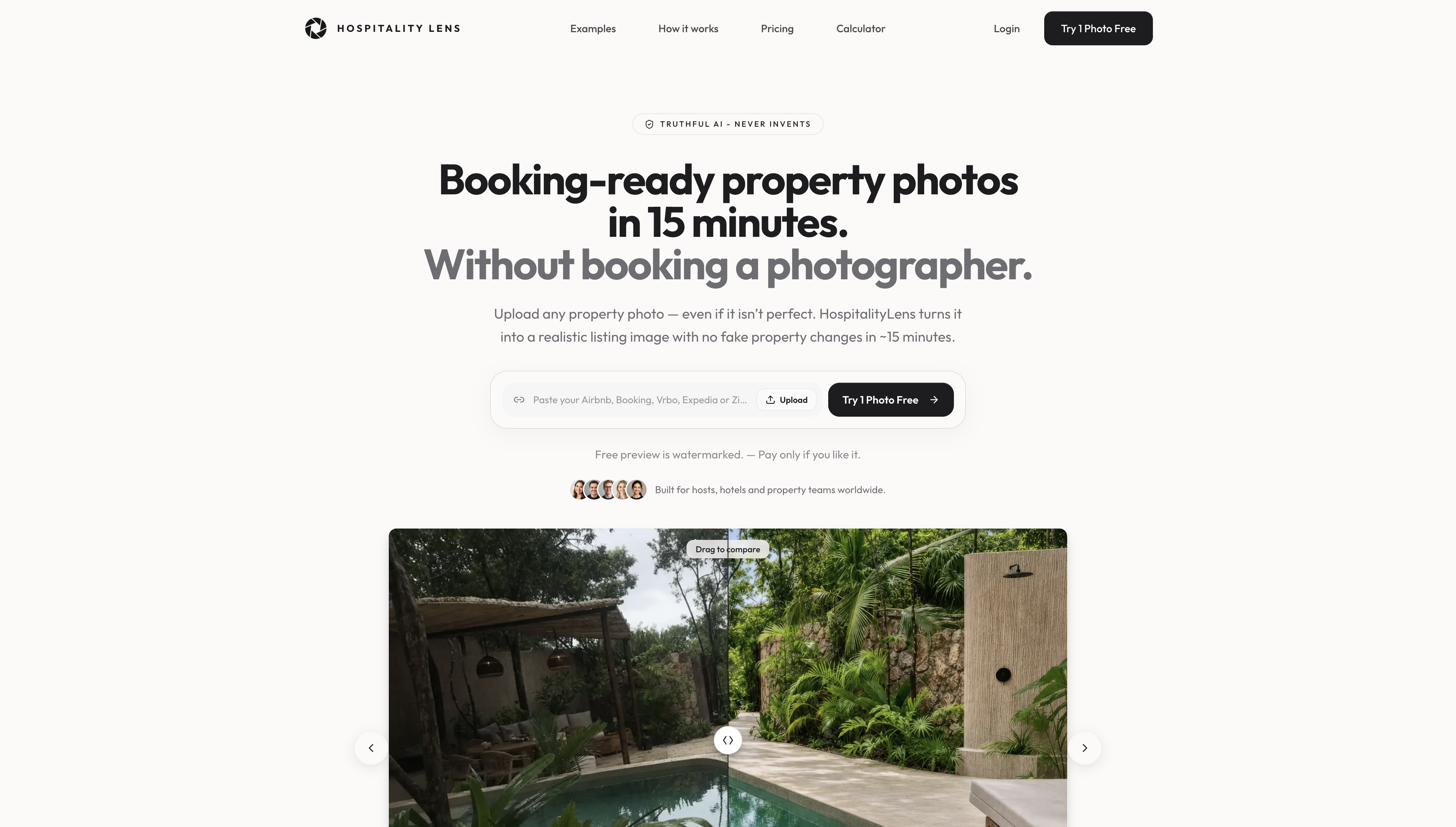
HospitalityLens offers a free watermarked preview on a real source photo before payment. If the result fits the listing, use the current pricing page for the finished image, packs, subscriptions, and current revision terms.
The lowest-risk experiment: pick your weakest-performing listing, try one photo free, run a 4-week test with pricing locked, and check your CTR and booking velocity. If the numbers move, you have your answer. If they do not, you have spent nothing. See how it works and decide from there.
FAQ
How much does professional real estate photography cost?
Prices vary by market, property size, deliverables, licensing, travel, and turnaround. Compare current local provider quotes or published packages rather than relying on one market-average range.
What is a realistic ROI on listing photo improvements?
There is no universal ROI percentage for listing-photo improvements. Calculate ROI from your own measured incremental revenue and actual photo cost, and treat assumed occupancy or ADR uplifts as scenario inputs rather than expected results.
When should you use AI enhancement vs. a full professional shoot?
Use enhancement when current source photos accurately show the property but need presentation fixes. Use a professional shoot when you need new angles, missing rooms or amenities, controlled lighting, styling, drone work, floor plans, video, or a full visual reset.
Airbnb publicly says listing quality—including photos and videos—and listing popularity or guest engagement can influence search ranking. Other platforms disclose different inputs, so do not assume every booking platform weights CTR, saves, or photo quality in the same way.
What makes a listing photo misleading vs. truthfully enhanced?
Truthful enhancement improves presentation while preserving the actual room, layout, permanent features, amenities, and view. Misleading edits materially change what a guest or buyer would expect to find.
Recommended