Hotels
How Photo Quality Supports Hospitality Revenue
Boost bookings and elevate revenue by optimizing your property’s visual appeal through enhanced photo quality and strategic image governance.
By Hospitality Lens · · 11 min read
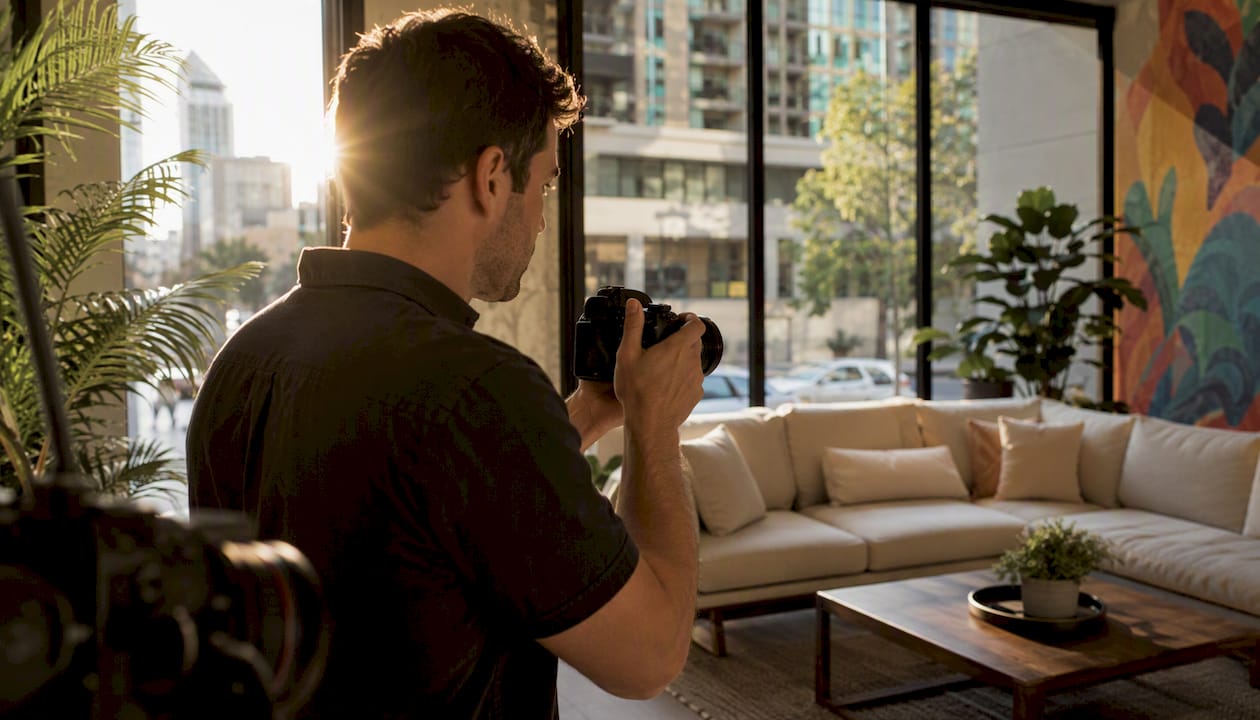
Better listing photos can improve how guests evaluate a property, but the size of any booking or revenue effect is property-specific. Peer-reviewed hospitality research supports a relationship between image characteristics and booking decisions; it does not justify a universal double-digit uplift. Start by improving the weakest, most decision-relevant images and measure the result against your own baseline.
Photo quality and image governance are practical parts of hospitality merchandising. Their financial value should be measured alongside pricing, availability, channel mix, demand, and the rest of the guest journey.
Table of Contents
Photos help guests understand a listing and can also be processed by platforms for operational purposes such as display, categorization, or quality checks. Do not assume that image processing proves a particular ranking effect unless the platform documents it.
On the emotional side, research on perceived transportation shows that larger, well-composed hotel photos increase a viewer’s sense of being “in” the space, which raises both booking intention and willingness to pay. A separate mechanism, perceptual fluency, explains why high-resolution images feel more trustworthy: when an image is easy to process visually, the brain attributes that ease to quality. Research on luxury hotel imagery confirms that clear, sharp photos lead guests to infer higher service quality, even before reading a single amenity description.

On the algorithmic side, image scoring and governance affect how platforms rank your listing in search results and how AI systems categorize your property’s features. Missing room types, low-resolution thumbnails, and absent metadata all reduce your distribution reach, often without any visible signal in your extranet.
Follow platform-ready specs and visual consistency to capture clicks and convert them on your direct site. The table below reflects guidance from OTA operators and direct-booking best practices.
| Spec |
OTA Listings |
Direct Website |
| File size target |
— |
— (CDN-served) |
| Orientation |
Landscape preferred |
Landscape preferred |
| Minimum shots per room type |
3–5 |
3–5 |
| Hero image requirement |
Bright exterior or signature room |
Signature room or lifestyle shot |
| Bathroom required |
Yes |
Recommended |
Beyond specs, your listing photo optimization workflow should cover file naming (descriptive, not “IMG_4421.jpg”), alt text for every image on your direct site, and hero selection based on click-through rate data rather than personal preference.
Pro Tip: The fastest technical fix that improves perceived quality without a reshoot is horizon correction. A photo that is even 2–3 degrees off-level reads as careless. Most editing tools correct this in one click, and it changes how guests perceive the entire listing.
Separate published platform rules from assumptions about proprietary ranking systems. Booking platforms publish photo and content requirements, but they do not all disclose the same image-scoring or ranking formula.
Airbnb is specific about its own system: its official search guidance says listing quality includes content such as photos and videos, while popularity includes guest engagement. Airbnb also says high-quality media can attract attention and improve engagement, which can improve ranking. That is useful first-party evidence for Airbnb; it should not be presented as proof that Booking.com, Expedia, Vrbo, or Google use the same inputs in the same way.
For every channel, follow the current first-party photo requirements, show rooms and amenities accurately, and treat third-party claims about hidden quality scores or machine-vision ranking models as unverified unless the platform documents them.
How to measure whether your photo changes affected revenue
Track the metrics your channels expose—listing views or impressions, engagement, direct-site conversion, bookings, ADR, and RevPAR where relevant—but do not assign a universal “meaningful change” threshold before you see your own baseline variability.
Record a representative baseline, note exactly when the image set changes, and avoid making major simultaneous changes to price, availability, promotions, or copy when practical. Use a comparison property or control period when you have enough traffic. The amount of data needed depends on listing volume and seasonality; there is no universal 30-, 60-, or 90-day minimum that guarantees clean attribution.
Report observed results as property-specific. If conversion moves after a photo refresh but price, demand, inventory, or channel mix also changed, call out those confounders rather than crediting the entire movement to photography.
Key Takeaways
| Point | Evidence-based takeaway |
|---|
| Images matter to guest evaluation | Hospitality research links image aesthetics and composition with booking-related decisions, but it does not establish one universal revenue uplift. |
| Four visual properties have research support | A peer-reviewed study of 1,350 hotel images identified shooting time, color scheme, human presence, and shooting angle as image properties associated with booking events. |
| Ranking claims must be platform-specific | Airbnb publicly connects listing quality, media, popularity, and engagement with ranking; do not extrapolate the same formula to every OTA. |
| Measurement is listing-specific | Use your own baseline, control confounding variables where possible, and avoid universal CTR, ADR, conversion, or timing thresholds. |
| Pricing should stay current | Use a free HospitalityLens watermarked preview to assess a real source photo, then check the current pricing page before purchasing an unlock or pack. |
What the evidence actually tells us about photo investment
There is a version of this conversation that overpromises. “Upgrade your photos and watch bookings pour in.” That framing is not wrong exactly, but it skips the part where you have to measure carefully, test incrementally, and stay honest about what your photos actually show.
The research is clear that photo quality affects perception, trust, and willingness to pay. What it does not tell you is that a single enhanced image will fix a pricing problem, a location disadvantage, or a review score issue. Photos are one lever among several, and they work best when the rest of the listing is already solid.
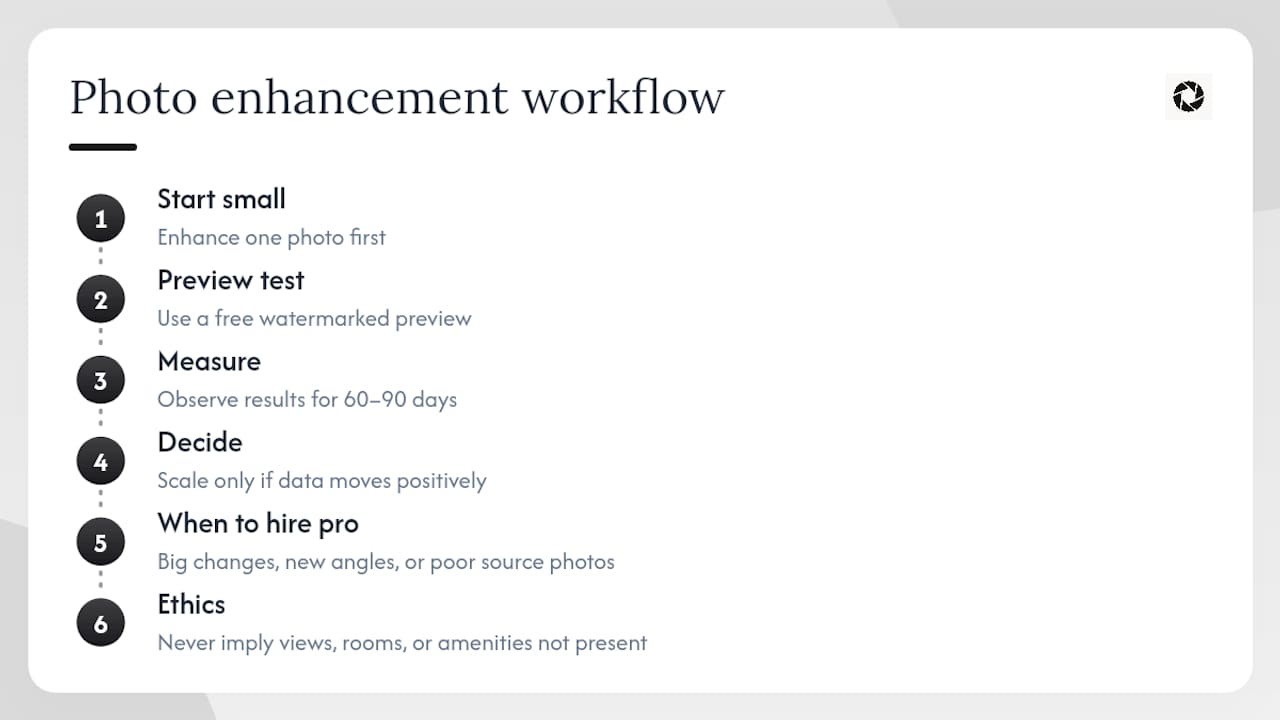
The HospitalityLens Team’s view: start with one photo, measure the result, and scale from there. That approach respects both your budget and your guests. A free watermarked preview costs you nothing to test. If the enhanced image looks right and the data moves in the right direction over 60–90 days, you have your answer.
We also want to be direct about when enhancement is not the answer. If your property has changed significantly, if you need angles that do not exist in your current set, or if your source photos are too dark or distorted to work from, a professional photographer is the better investment. Enhancement improves what is genuinely there. It does not invent what is not.
One ethical line that should not move: never use photos that imply a view, a room, or an amenity that guests will not find on arrival. The trust damage from that mismatch, particularly for first-time guests, outweighs any short-term conversion gain.
See what one enhanced photo does for your listing
Current HospitalityLens pricing (USD); one-time packs — The Hero: 1 photo for $12; The Refresh: 10 photos for $59; The Property: 25 photos for $129; The Portfolio: 100 photos for $399; monthly subscriptions — THE STARTER: 10 photos/month for $49/month; THE OPERATOR: 25 photos/month for $99/month; THE PORTFOLIO: 100 photos/month for $299/month; one-time pack credits do not expire; monthly subscription credits remain valid for up to 3 months; 2 free revisions per photo on one-time packs; 3 free revisions per photo on monthly subscriptions. See current pricing.
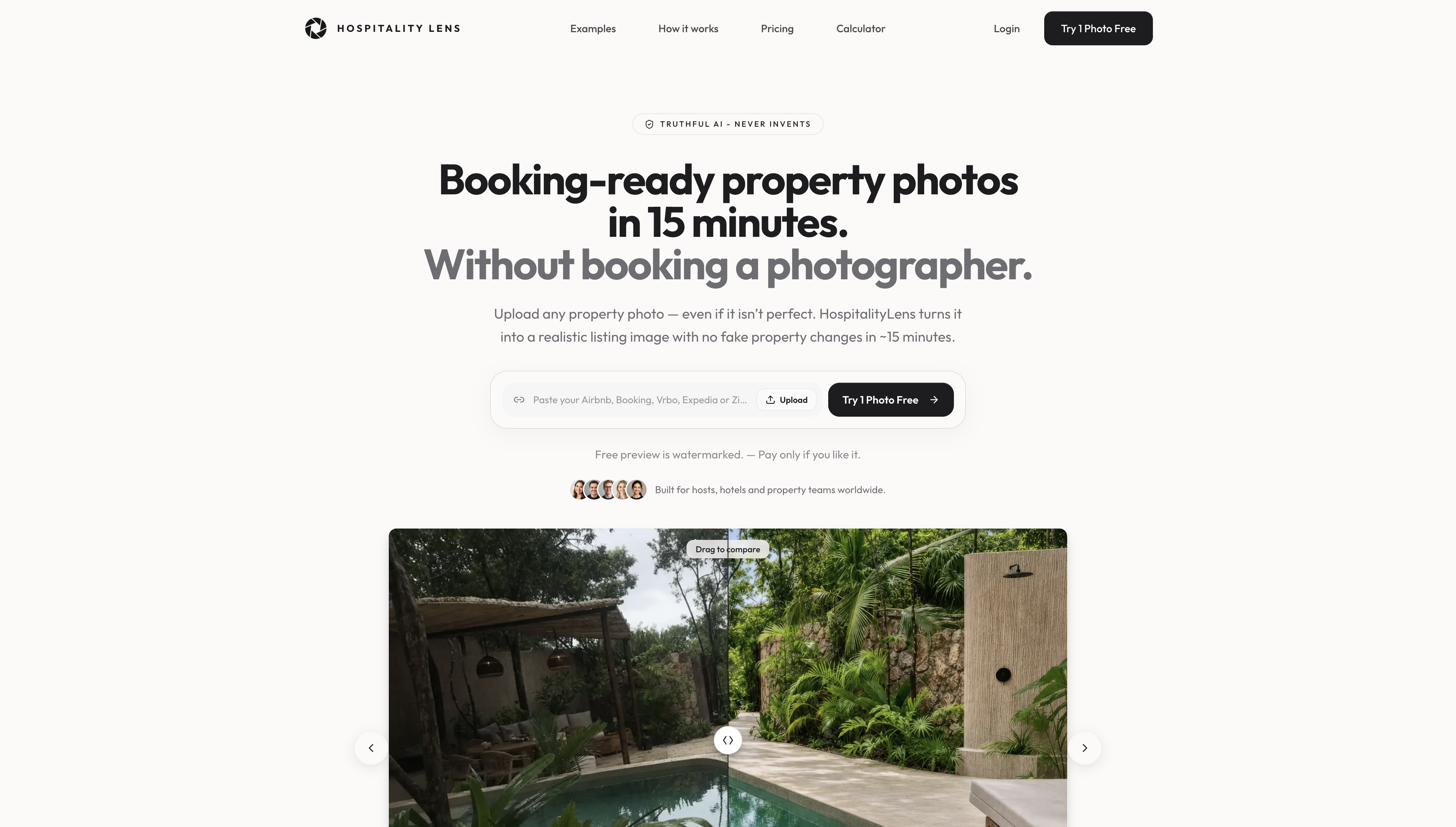
Free watermarked preview. Pay only if you like it. No card is required to create the free watermarked preview. See current pricing for unlocks, one-time packs, and subscriptions.
Try one photo free at HospitalityLens and measure the before/after in your OTA extranet over the next 60–90 days. The step-by-step guide walks you through submission, revisions, and how to push approved images to your channels.
Useful sources
The claims in this article draw on the following academic and industry sources. Each is linked for verification.
- The effects of the aesthetics and composition of hotels’ digital photo images on online booking decisions | Humanities and Social Sciences Communications
- ScienceDirect article on photograph sizes and perceived transportation (hotel websites)
- Looks clear and sounds familiar: how consumers form inferential beliefs about luxury hotel service quality
- Why Scoring Hotel Image Quality Matters More Than Ever - Hospitality Net
- Hotel Photography 2026: 13 Shots That Lift Direct Bookings
- Top 20 Ways to Increase Hotel Revenue — NetSuite
- AI Hotel Photos in 2026: A Hotelier’s Guide to Cost & Trust
FAQ
How much can better photos increase hotel bookings?
There is no universal percentage by which better photos increase hotel bookings. Published hospitality research links image characteristics with booking-related decisions, so measure the effect using your own property and channel data rather than assuming a fixed uplift.
What photo characteristics does hospitality research identify?
A peer-reviewed study of 1,350 hotel images identified shooting time, color scheme, human presence, and shooting angle as image properties associated with booking events. The study supports their relevance but does not prove that changing any one property will produce a guaranteed conversion increase.
When should I hire a photographer instead of using AI enhancement?
Hire a photographer when the listing needs new capture, missing angles, controlled lighting, styling, drone work, floor plans, video, or source photos that are unusable. Enhancement fits current source photos that accurately show the property but need presentation improvements.
How long does it take to see revenue impact from photo changes?
There is no universal measurement window. Use enough pre- and post-change data for your property volume and seasonality, document confounding changes, and report observed results rather than attributing every movement to the photos.
Can I try AI photo enhancement before committing to a full package?
Yes. HospitalityLens offers a free watermarked preview on your first photo with no card required. Review the result first, then check current pricing if you want the full-resolution, watermark-free commercial-use image.
Recommended