Short-Term Rentals
Why Better Listing Photos Can Support More Bookings
Invest in high-quality property photography to significantly boost bookings, increase revenue, and enhance your visual presence across all listing platforms.
By Hospitality Lens · · 10 min read
Why Photo Investment Translates to More Bookings
TL;DR:
- High-quality, accurate photos can improve how guests evaluate hotels and property listings, but booking and revenue effects vary by property and channel.
- Regular updates and strategic ordering of images improve guest trust, engagement, and conversion rates.
Photo investment should be evaluated as part of the property’s broader merchandising and distribution strategy, not as a guaranteed return. Peer-reviewed hospitality research supports the relevance of image presentation to booking-related decisions, while the actual financial effect depends on the property, channel, price, demand, existing gallery, and other listing factors.
Why photo investment translates to more bookings starts with the first click
The cover photo is often the first visual element a guest sees in search results. Make it clear, representative, and readable at thumbnail size, but do not assume a universal three-second decision window or treat imagery as the only factor in a click.

Photo quality functions as a trust proxy. When a guest sees a dark, crooked, or cluttered image, they do not think “bad photo.” They think “bad property.” The image carries the full weight of their first impression, and that impression shapes everything that follows.
The first four photos in a listing’s carousel carry disproportionate weight on viewing and booking likelihood. Strategic ordering of those four images can increase “view all photos” clicks and reduce the guest concerns that kill conversions. A strong opening sequence pulls guests deeper into the listing rather than sending them back to the search results.
Visual impact consistently outperforms descriptions, review scores, and price on initial decisions. You can write the most accurate, detailed property description available, and it will not save a weak cover photo. The photo earns the click. Everything else closes the booking.
Pro Tip: Place your most appealing room shot as the cover photo, not the exterior. Guests book rooms, not buildings. The exterior can appear later in the carousel once you have already earned their attention.
What the evidence supports about photo quality and bookings
Hospitality research supports a relationship between image presentation and booking-related decisions, but it does not provide one universal percentage by which better photos increase bookings or revenue.
A peer-reviewed analysis of 1,350 Booking.com hotel images identified shooting time, color scheme, human presence, and shooting angle as image properties associated with booking events. That is useful evidence that image choices matter. It is not evidence that every property will gain a fixed amount of bookings, earnings, CTR, or direct-site conversion after a refresh.
The correct financial question is property-specific: what did the image work cost, what changed in the listing, what happened to the metrics you can observe, and what other variables changed at the same time?
Use enough photos to cover the property accurately without padding the gallery with near-duplicates. There is no universal optimum such as 15, 22, or 30 images that guarantees better conversion across every hotel or short-term rental.
Order the gallery to help guests understand the property: lead with a strong representative image, then cover important rooms, bathrooms, amenities, exterior areas, and material details in a logical sequence. Refresh photos when renovations, furniture, amenities, views, or other conditions make the existing set inaccurate or materially outdated.
How photos work alongside pricing and your booking funnel
Photography is one part of the commercial offer. Price, availability, reviews, location, policies, page speed, booking friction, and channel mix can all change outcomes at the same time. Better images do not repair an uncompetitive rate or a broken booking flow.
If you want to quantify the value of a photo refresh, record your own baseline, document the image change, keep other variables as stable as practical, and compare a representative period afterward. Treat any observed lift as specific to that listing unless you have enough controlled evidence to generalize it.
Key Takeaways
| Point | Evidence-based takeaway |
|---|
| Photo quality matters | Hospitality research links image characteristics with booking-related decisions, but not with one universal uplift. |
| Coverage beats a magic count | Show the important spaces clearly and remove near-duplicates rather than optimizing toward an unsupported photo-count benchmark. |
| Refresh when reality changes | Update images when the current gallery no longer represents the property accurately. |
| Measure your own return | Use actual media cost and observed listing performance while controlling for price, availability, and seasonality where possible. |
| Use the right production method | Enhance usable source photos; commission new capture when you need new angles, missing coverage, or specialized production. |
A practical way to think about photo investment
Do not start with a promised ROI percentage. Start with the current gallery. Identify images that are inaccurate, outdated, dark, distorted, repetitive, or missing important coverage, then choose the least costly truthful way to fix those specific problems.
For some properties that means a new professional shoot. For others it means improving usable existing images. The right investment is the one that produces accurate, decision-useful coverage at a cost the property can justify.
Better listing photos, without booking a photoshoot
HospitalityLens enhances existing property photos into booking-ready listing images without requiring a new photoshoot. You upload your current photos, whether they are dark, cluttered, or shot on a phone, and receive professionally enhanced results with corrected lighting, color, and perspective.
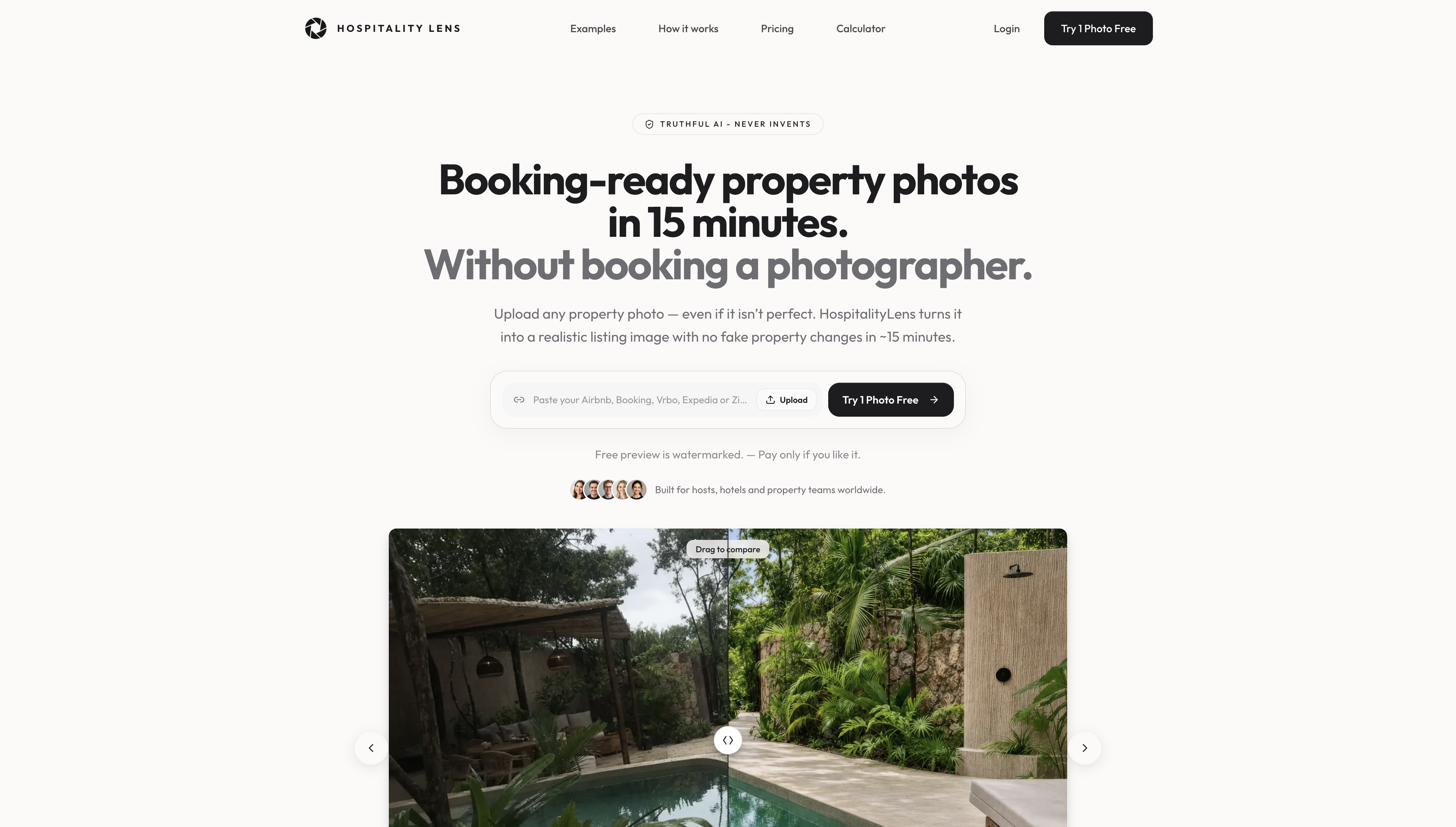
The service covers lighting and color correction, clutter cleanup, people and object removal, and overall visual polish, all while preserving the real property accurately. Enhanced photos include commercial usage rights and transparent pricing. The step-by-step guide walks you through the full process from upload to final image. You can also try one photo free to see the difference before committing to a full set.
FAQ
How much do professional photos increase bookings?
There is no universal percentage. Hospitality research links image presentation with booking-related decisions, but the effect varies by property, market, price, channel, existing photo quality, and the rest of the listing.
How many photos should a property listing have?
Use enough images to cover every guest-relevant room, amenity, exterior area, and material detail without padding the gallery with near-duplicates. Follow the current requirements of each channel.
How often should listing photos be updated?
Update the gallery when renovations, furnishings, amenities, views, seasonal conditions, or other material details make the existing images inaccurate or meaningfully outdated. There is no universal two- or five-year conversion rule.
Can better photos justify a higher nightly rate?
Better presentation can help guests understand what a property offers, but achievable rate depends on market demand, location, amenities, reviews, competition, availability, and pricing strategy as well as imagery.
Do I need a professional photographer, or can I enhance existing photos?
Use enhancement when existing images accurately capture the property but need presentation fixes. Hire a photographer when you need new angles, missing rooms or amenities, controlled lighting, styling, drone work, floor plans, video, or unusable source photos.
Recommended