Real Estate
How Photography Drives Home Sale Speed in 2026
Boost your home's selling speed by 32% with professional photography, attracting more buyers and securing swifter, more profitable offers.
By Hospitality Lens · · 11 min read
TL;DR:
- Professional real estate photography can improve how clearly a home is presented online, but no universal percentage determines how much faster a property will sell or how much more it will sell for. Preparation, accurate coverage, and a strong lead image help buyers evaluate the listing; actual results still depend on the property, pricing, and market.
Listing photography is an important part of how buyers evaluate a home online, but it is not the single determinant of sale speed. The 2025 NAR Home Buyers and Sellers Generational Trends report found that 83% of buyers who used the internet rated photos as a very useful website feature. That supports investing in clear, accurate imagery without promising a fixed reduction in days on market.
How does professional photography impact buyer engagement online?
The listing photo is emotional before it is rational. Eye-tracking research shows buyers spend just 1–3 seconds on the hero image before deciding to click or scroll past. If that first image does not stop them, nothing else about your listing gets seen.
Once a buyer does click, they spend roughly 20 seconds studying the hero photo in detail. That means your lead image carries two jobs: earn the click, then hold attention long enough to create interest. A dark, crooked, or cluttered photo fails both tests in under three seconds.
The impact on views is significant. Strong listing photos can help a property earn attention online, but view counts and sale speed depend on price, inventory, location, condition, distribution, and market demand as well as photography.
The first 48 hours online are the most critical window for any listing. Buyers and their agents monitor new listings closely during this period. A listing that launches with weak photos loses momentum immediately, and that momentum is very hard to recover even if you swap photos later.
Pro Tip: Schedule your photoshoot two to three days before your listing goes live. This gives you time to review, request corrections, and publish with confidence rather than rushing with whatever images arrive the morning of launch.
What types of real estate photos maximize home sale speed?
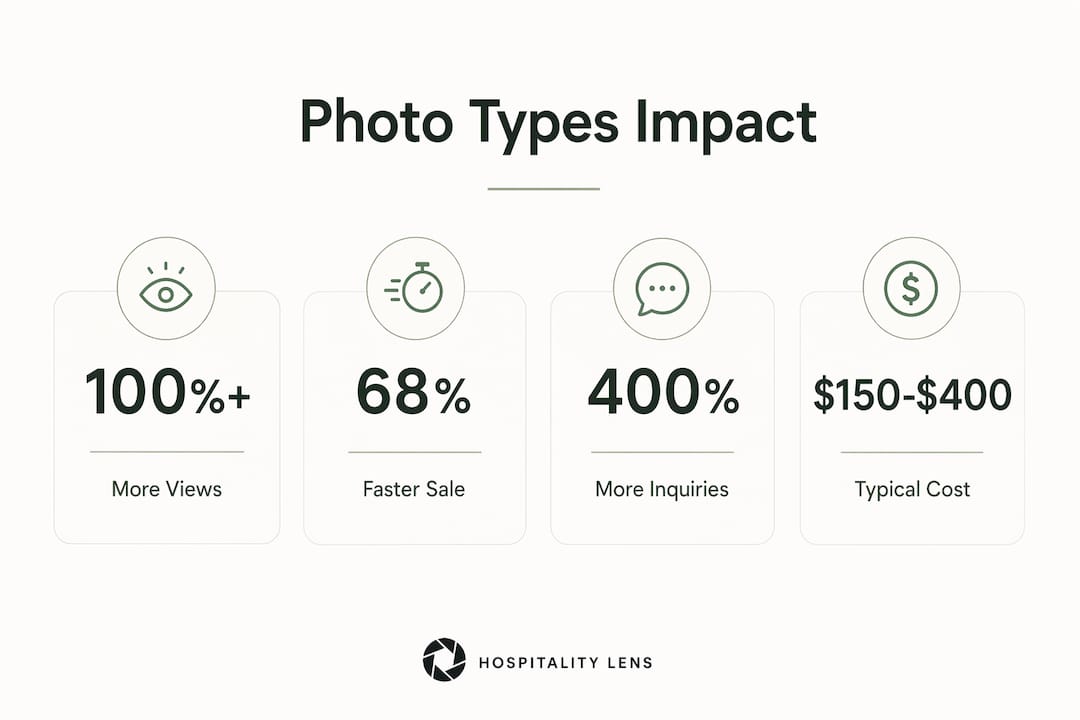
Not all photo types perform equally. Understanding which formats drive the most buyer action helps you spend your photography budget where it counts.
HDR photography as the foundation
High Dynamic Range (HDR) photography is the standard technique for interior real estate shots. It blends multiple exposures to show both bright windows and shadowed corners in the same frame. Without HDR, interiors either look washed out near windows or dark everywhere else. HDR is not a luxury upgrade. It is the baseline expectation for any listing that wants to compete.
Drone and aerial photography
Aerial drone photos can add useful context for properties where land, waterfront, access, or surroundings are material to the buyer decision. Large lots, waterfront locations, mountain views, and homes with strong curb appeal all benefit from aerial context that ground-level shots cannot provide. For a standard urban townhouse, drone photos add less value. Match the tool to the property.
The hero shot: daytime exterior wins
Counter to what many sellers assume, standard daytime exterior shots outperform twilight and drone shots on click-through rates. There is no universal click-through benchmark proving that daytime exterior photos outperform twilight images for every listing. Choose the lead image that most clearly and accurately communicates the property at thumbnail size, then measure performance in the channel data available to you.
Video tours and 3D virtual tours
Video and 3D virtual tours can help remote and out-of-market buyers understand layout before arranging a visit. NAR research also shows buyers value virtual tours as an online-search feature, but there is no universal inquiry uplift that should be expected from adding one.
Pro Tip: If your budget allows only one media upgrade beyond standard photos, choose a 3D virtual tour. It does the most work for out-of-market and relocation buyers who cannot visit in person before making an offer.
How does home preparation affect real estate photography results?
Professional photographers cannot fully compensate for a cluttered or poorly staged home. This is one of the most common and costly mistakes sellers make. They invest in a photographer but skip the preparation, then wonder why the photos look flat.
Staging for the camera requires specific actions that differ from how you would clean for a showing. The camera sees everything differently than the human eye. Shadows appear darker, clutter reads louder, and personal items create distance rather than warmth.
The preparation steps that matter most follow a clear sequence. Remove personal photos and excess furniture first. Cameras make rooms look smaller, so less is always more. Next, turn on every light in the house, including lamps, under-cabinet lights, and closet lights. Open all blinds and curtains to pull in natural light. Turn off ceiling fans, which blur in photos. Clear countertops completely, leaving only one or two intentional items. Finally, move cars out of the driveway and tidy the front entrance.
Homes staged specifically for photography attract more buyers and spend less time on the market. The photos help buyers see themselves living in the space, which speeds the emotional decision to schedule a showing. Clean, but not sterile. Prepared, but not staged to the point of feeling fake.
The most common mistake is leaving too much on surfaces. A kitchen with a coffee maker, a fruit bowl, a cookbook, a dish rack, and a paper towel holder reads as cluttered in photos even if it feels normal in person. For the shoot, remove everything and add back only one or two items with intention.
Photography is the foundation of your listing media strategy, not a standalone expense. Every other media asset, including video, drone footage, and 3D tours, depends on the quality of your core photo set to establish credibility first.
A complete media set works together in a specific way. Buyers typically see the hero photo in search results, click through to browse the full photo gallery, then watch the video tour if one exists, and finally explore the 3D tour before scheduling a showing. Each layer filters and qualifies the buyer further. By the time they call, they already know the layout, the light, and the feel of the home.
Coordinating photos with video and drone footage prequalifies remote buyers and improves inquiry quality. This matters especially in markets where a significant share of buyers relocate from other cities or states. A buyer in Chicago considering a home in Austin will not fly out for a showing without first doing a virtual walkthrough. Your media set is what makes that decision possible.
Timing also matters. Photos delivered within 24 hours of the shoot capture the listing’s freshness and allow you to go live during that critical first 48-hour window. Delays in photo delivery push your launch date back and cost you momentum before buyers even see the home.
You can also learn from listing image optimization practices used in short-term rental markets, where photo quality directly drives booking revenue. The principles translate directly to residential sales.
What is the financial ROI of professional real estate photography?
The financial case for professional photography is straightforward. There is no guaranteed sale-price premium attributable to photography alone. Price outcomes depend on the home, market, pricing strategy, competition, condition, staging, negotiation, and other factors. Treat photography as part of the listing presentation rather than a promised investment return.
The time savings compound the financial benefit. Selling three to four weeks faster eliminates mortgage payments, utility bills, insurance costs, and the psychological cost of an extended sale. For a seller carrying a $2,500 monthly mortgage, three fewer weeks on market saves roughly $1,875 in payments alone, before accounting for any price premium.
More online views also create competitive conditions. When multiple buyers engage with a listing simultaneously, the seller gains negotiating leverage. Competitive offers push prices up and reduce the likelihood of buyers requesting concessions. Professional photos do not just sell homes faster. They create the conditions for better offers.
Professional photography pricing varies materially by market, property, licensing, travel, and deliverables. Compare current local quotes and decide whether new capture, targeted enhancement, or a mix of both is appropriate for the listing.
Key Takeaways
Photography is an important part of online listing presentation, but its individual effect on days on market or final sale price cannot be guaranteed.
| Point |
Details |
| Photography speeds up sales |
Clear professional photos help buyers evaluate a listing online; sale speed still depends on the wider market and listing strategy. |
| Hero image drives clicks |
Buyers decide to click or scroll in 1–3 seconds, making the lead photo the most critical asset. |
| Daytime exterior outperforms |
Standard daytime exterior shots achieve higher click-through rates than twilight or drone hero images. |
| Staging before the shoot matters |
Decluttering, turning on lights, and clearing surfaces directly improve photo quality and buyer response. |
| Full media sets prequalify buyers |
Combining photos, video, and 3D tours filters out unqualified inquiries and speeds the path to an offer. |
What we have learned from watching listings succeed and fail
The HospitalityLens Team’s perspective
The sellers who move fastest are not always the ones with the most expensive homes or the best locations. They are the ones who treat photography as a foundational decision, not an afterthought.
We see the same pattern repeatedly. A seller spends months preparing their home for sale, then rushes the photography because the listing date is approaching. The photos go live dark, slightly crooked, with a ceiling fan blurred mid-spin and a kitchen counter full of appliances. The listing sits. The seller assumes the market is slow. The market is not slow. The photos are the problem.
The uncomfortable truth about the impact of photography on home sales is that buyers do not give listings a second chance. If early engagement is weak, review the full listing rather than assuming an irreversible algorithm penalty. Better photos can still improve presentation later, alongside changes to pricing, description, availability, and promotion.
What actually works is simple preparation combined with honest photo improvement. You do not need a perfectly staged showroom. You need a clean, well-lit, accurately represented home that helps buyers picture themselves there. That is a realistic goal for almost any property.
The sellers who move fastest also coordinate their media assets before launch, not after. Photos, video, and 3D tours ready on day one. Listing goes live Thursday evening to capture weekend search traffic. Showings scheduled for Saturday. Offers reviewed Sunday. That sequence is not luck. It is preparation.
— The HospitalityLens Team
Listing photos that are ready before your launch date
Getting your photos right before your listing goes live is the single step most sellers skip. HospitalityLens helps real estate sellers and their agents turn existing or newly shot property photos into booking-ready listing images without scheduling a new photoshoot.
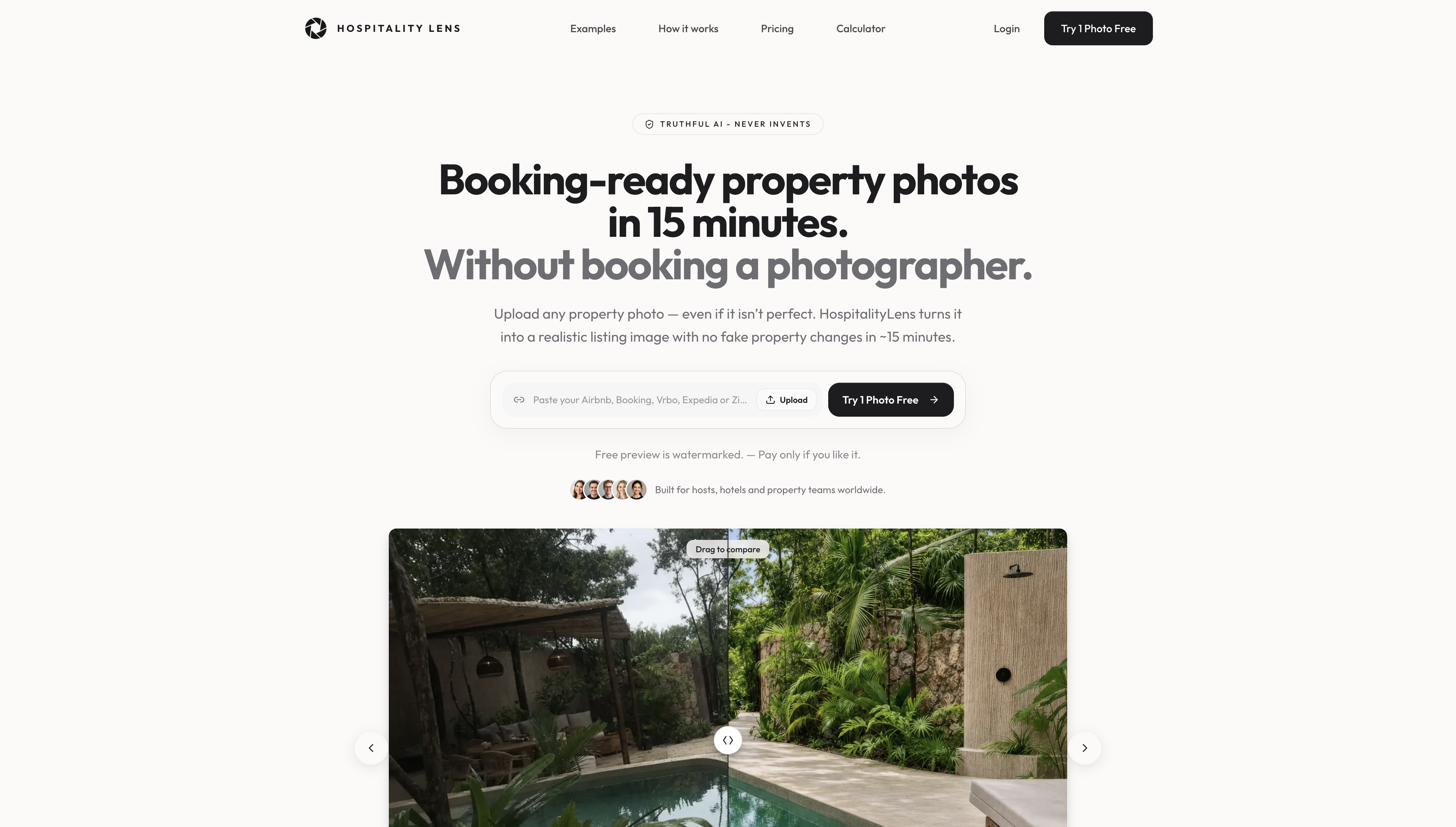
Upload photos that are dark, crooked, or cluttered and receive professionally enhanced images with corrected lighting, straightened horizons, and cleaned-up spaces. Every enhancement preserves the real property. No fake staging, no invented amenities. Just an honest, polished version of what you already have. You can create a free watermarked preview before paying. See current HospitalityLens pricing for the finished image, packs, and current revision terms. The step-by-step guide walks you through the full process in minutes.
FAQ
How much faster do homes sell with professional photos?
There is no universal percentage by which professional photos make a home sell faster. NAR research shows photos are highly useful to online buyers, while actual sale speed also depends on price, market conditions, inventory, location, condition, and marketing.
Does the type of hero photo affect how many buyers click?
The lead image matters because it is often a buyer’s first visual impression, but there is no universal CTR benchmark that applies to every listing. Choose the clearest, most representative hero image and measure your own channel performance.
Do video tours and 3D tours actually speed up sales?
Video and 3D tours can help buyers understand layout and can be particularly useful for remote buyers. NAR research shows virtual tours are valued by online buyers, but there is no universal inquiry uplift that should be expected.
How important is home staging before a photoshoot?
Prepare the home so the photos accurately show its condition and layout. NAR guidance recommends decluttering, cleaning, arranging rooms for the camera, and keeping the property consistent with what buyers will see in person.
What financial return does professional photography generate?
There is no guaranteed dollar premium attributable to professional photography alone. Evaluate the photography cost against the property, local market, listing strategy, and the quality of the existing images rather than assuming a fixed return.
Recommended