Real Estate
Luxury Property Photo Styles: Examples and Inspiration
Unlock your property's full potential and captivate high-end buyers with stunning photo styles that highlight its unique charm and premium features.
By Hospitality Lens · · 12 min read
TL;DR:
- Luxury property photography emphasizes mood, craftsmanship, and style through techniques like twilight, aerial, and detail shots. Combining these styles into a cohesive visual narrative helps attract high-end buyers and showcase a property’s unique features effectively.
Luxury property photo styles are specialized photographic approaches that highlight a property’s design, ambiance, and exclusivity through techniques like twilight shooting, aerial views, architectural close-ups, and cinematic storytelling. These are not simply “better real estate photos.” They draw from architectural photography, a discipline that is emotional and brand-focused rather than purely informational. Premium luxury shoots typically include pre-shoot consultation, professional lighting, and curated galleries with 5–7 day delivery. For $5M+ estates, twilight and aerial photography are standard requirements, not optional upgrades. Understanding each style helps you select the right mix for your property and your buyers.
1. Examples of luxury property photo styles: twilight photography
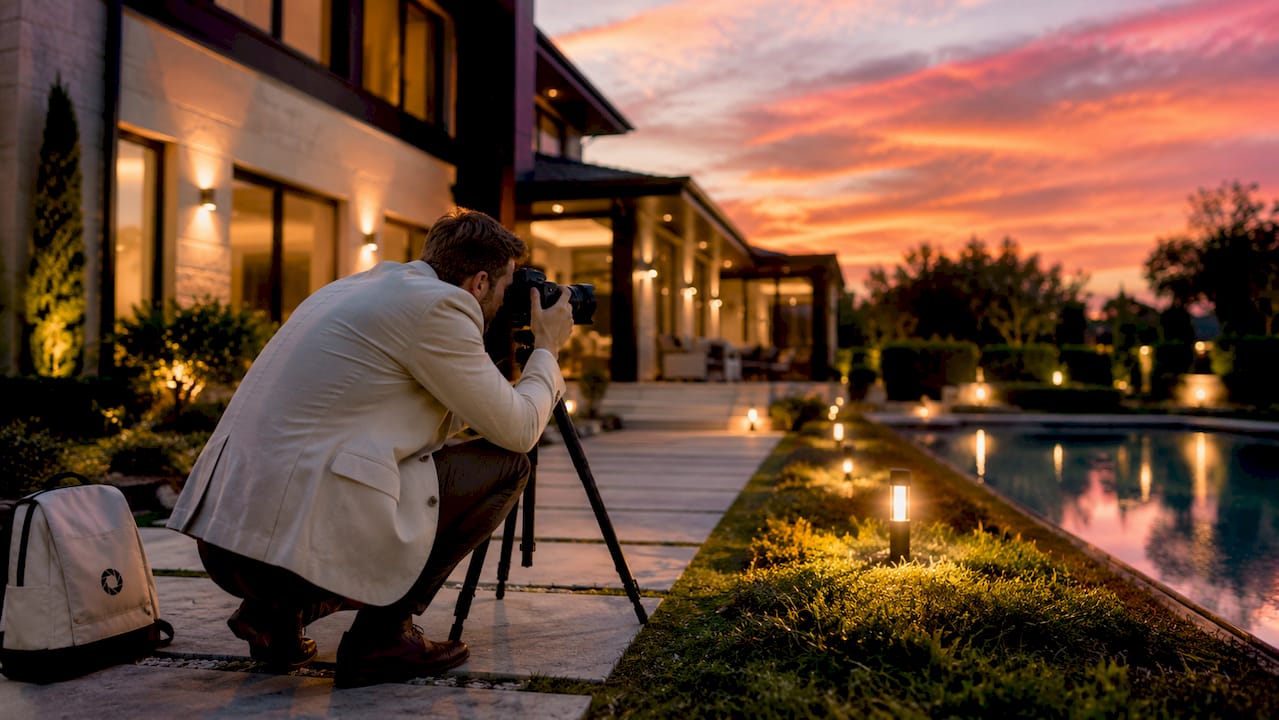
Twilight photography is the single most recognized style in luxury real estate photography. It captures the warm interior glow of a home set against a dramatic dusk sky, creating a mood that no daytime shot can replicate. Twilight images generate higher buyer engagement and faster showings than standard daytime exteriors for listings priced at $1M and above. That performance gap is not accidental. Twilight photography works because it triggers an emotional response before the buyer processes a single square foot.
The style works best for specific property types. Listings with pools, exterior lighting, or extraordinary views benefit most, because twilight reveals lighting that is invisible during daylight hours. A pool with underwater lights, a terrace with lanterns, or a hillside home with a city view below all become dramatically more compelling at dusk. For properties without these features, the impact is more modest.
Execution requires precise timing. The optimal shooting window is roughly 20–30 minutes after sunset, when the sky holds color but the ambient light still balances with interior illumination. Miss that window and the sky goes black, flattening the effect entirely.
- Scout the property exterior at least one hour before the shoot to identify the best angles.
- Coordinate interior lighting in advance: turn on all lamps, under-cabinet lights, and pool lights before the window opens.
- Check weather forecasts 48 hours out. Overcast skies diffuse light evenly and often produce richer colors than clear skies.
- Shoot multiple angles during the window. You will not get a second chance that evening.
Pro Tip: Schedule twilight shoots on days when thin cloud cover is forecast. A completely clear sky can produce a flat, dark blue backdrop, while light clouds add texture and warmth to the frame.
2. How aerial and drone photography enhance luxury property presentation
Aerial photography shows what no ground-level shot can: the full scale of an estate, its relationship to the surrounding landscape, and the context that makes a location genuinely exclusive. Drone aerials at twilight show estate scale and landscape lighting simultaneously, which is particularly powerful for large properties where the grounds are as significant as the structure itself. That combination of scale and mood is difficult to communicate through any other medium.
The style is most effective for large estates, coastal properties, properties on elevated terrain, and any listing where the land itself is a selling point. A beachfront home photographed from 200 feet above communicates proximity to the water far more convincingly than any interior shot. A mountain retreat photographed from the air shows the isolation and privacy that buyers in that segment are paying for.
Practical execution requires attention to regulation and craft. Drone pilots must hold FAA Part 107 certification for commercial shoots in the United States. Flights near airports or in controlled airspace require prior authorization through the FAA’s LAANC system. Beyond compliance, compositional skill matters. The best aerial shots use leading lines, natural framing, and deliberate altitude choices rather than simply pointing the camera down.
- Use drone aerials to establish the property’s relationship to water, mountains, or city skylines.
- Combine aerial stills with aerial video for a more complete picture of the grounds.
- Shoot aerials at both midday and twilight when the property warrants it. Each produces a distinct mood.
- Integrate aerial shots into the listing gallery early, not buried at the end. Buyers use them to orient themselves.
Ground-level and aerial shots serve different purposes. Ground shots communicate interior quality and architectural detail. Aerial shots communicate location, scale, and lifestyle. The strongest luxury listing galleries use both.
3. Architectural detail photography and its role in communicating craftsmanship
Architectural detail photography focuses on the materials, finishes, and craftsmanship that separate a luxury property from a merely expensive one. Custom millwork, hand-laid stone, bespoke hardware, and coffered ceilings are the details that justify a price point. A wide-angle room shot cannot communicate these things. A tight, well-lit close-up can.
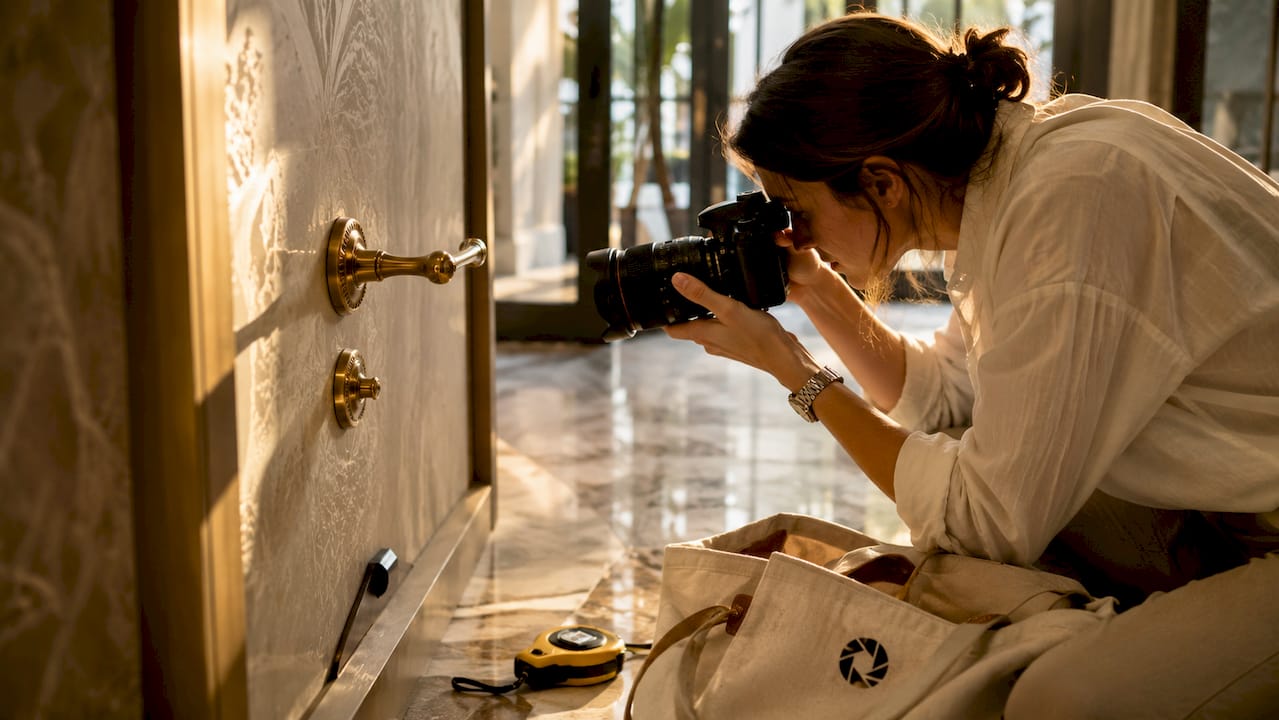
Architectural photography is emotional and brand-focused, not simply informational. This distinction matters in practice. Real estate photography documents a space. Architectural photography interprets it. For luxury listings, interpretation is the job. Buyers at this level are not just purchasing square footage. They are purchasing a standard of craft and a way of living.
Effective detail shots require deliberate lighting and precise focus. Raking light, placed at a low angle to the surface, reveals texture in stone and wood that flat frontal lighting erases. A tilt-shift lens or careful focus stacking keeps the critical plane sharp while allowing natural depth to fall away. The goal is clarity, not clinical sharpness throughout the entire frame.
- Focus on materials that are genuinely custom or rare: book-matched marble, hand-forged ironwork, reclaimed timber.
- Avoid over-processing. Buyers prefer natural warmth and authentic textures over heavily filtered images.
- Shoot details in context when possible. A close-up of a fireplace surround reads better when the surrounding room is visible at the edge of the frame.
- Include at least 4–6 detail shots in any luxury listing gallery. They function as proof of quality.
Pro Tip: Apply minimal retouching to detail shots. Aggressive color grading or texture smoothing removes the very qualities that make custom materials worth photographing. Preserve grain, variation, and natural color.
4. Integrating cinematic video and virtual tours with luxury photography
Cinematic video and virtual tours do not replace still photography in luxury marketing. They extend it. A well-produced video walk-through gives buyers a sense of flow and proportion that even the best still images cannot fully convey. Combining architectural stills, cinematic video, and aerial shots creates a cohesive narrative that increases credibility for global and remote buyers. That credibility matters more as international buyers make purchase decisions without visiting in person.
The key word is “cohesive.” Video and stills shot on different days, with different lighting setups and different color grades, produce a fragmented impression. Buyers notice the inconsistency even when they cannot name it. The most effective luxury marketing packages treat all visual media as a single production, planned and executed under a unified aesthetic.
Narrative-driven imagery places the property in its geographic and lifestyle context. A coastal estate video might open with a drone shot approaching from the water, transition to the entry sequence, and move through the main living spaces to the terrace view. That arc tells a story. It is not documentation. It is an argument for why this property is worth the price.
Virtual tours serve a different function. They give buyers control, letting them explore at their own pace and return to specific rooms. For properties marketed internationally, virtual tours reduce the friction of a long-distance purchase decision. They are most effective when built from the same high-quality still images used in the listing gallery, maintaining visual consistency throughout.
5. Choosing photo styles based on property type and marketing goals
The right mix of photo styles depends on what the property offers and who you are trying to reach. Not every luxury listing needs every style. A penthouse condominium with floor-to-ceiling city views needs twilight photography and strong interior sequences. It does not necessarily need aerial drone work, because the view from inside already communicates height and context. A sprawling coastal estate needs aerials, twilight, architectural detail, and video. The property’s features determine the brief.
Luxury property shoots often span multiple days to capture architectural details, aerial views, and varied lighting conditions coherently. Three-day production blocks are common for elite estates. Smaller luxury condos or townhomes can typically be covered in a single well-planned day. Matching shoot scope to property scale keeps budgets rational and results focused.
The table below maps common property types to the photo styles that serve them best.
| Property type |
Primary styles |
Secondary styles |
Marketing goal |
| Oceanfront or lakefront estate |
Aerial, twilight, cinematic video |
Architectural detail, virtual tour |
Communicate location and scale |
| City penthouse or high-rise condo |
Twilight interior/exterior, architectural detail |
Virtual tour |
Showcase views and finish quality |
| Mountain or rural retreat |
Aerial, daytime exterior, cinematic video |
Architectural detail |
Convey privacy and landscape |
| Historic or architecturally significant home |
Architectural detail, interior sequences |
Twilight exterior |
Highlight craftsmanship and character |
| New construction luxury home |
Architectural detail, twilight, aerial |
Cinematic video |
Establish quality and aspirational lifestyle |
Pre-shoot consultation is the most underused tool in luxury real estate photography. A 30-minute conversation between the photographer, the listing agent, and the property owner before the shoot determines which styles to prioritize, which features to highlight, and how to sequence the gallery for maximum impact. Properties that skip this step often produce technically competent images that fail to tell a coherent story.
Pro Tip: Build your shot list around the three features that make this specific property worth its price. Every style choice should serve those three features. If twilight does not serve them, do not force it.
Key takeaways
The most effective luxury real estate photography combines twilight shooting, aerial perspectives, and architectural detail work into a single cohesive visual narrative planned before the first shot is taken.
Current HospitalityLens pricing (USD); one-time packs — The Hero: 1 photo for $12; The Refresh: 10 photos for $59; The Property: 25 photos for $129; The Portfolio: 100 photos for $399; monthly subscriptions — THE STARTER: 10 photos/month for $49/month; THE OPERATOR: 25 photos/month for $99/month; THE PORTFOLIO: 100 photos/month for $299/month; one-time pack credits do not expire; monthly subscription credits remain valid for up to 3 months; 2 free revisions per photo on one-time packs; 3 free revisions per photo on monthly subscriptions. See current pricing.
What the industry gets wrong about luxury photography
The most common mistake in luxury real estate photography is treating style as a checklist. Twilight shot: done. Drone: done. Detail photos: done. The images look technically correct and feel completely flat. That happens when style choices are made without a clear idea of what story the property needs to tell.
The distinction between real estate photography and architectural photography is not just academic. Real estate photography is informational; architectural photography is emotional. Luxury listings need the latter. Buyers at this level are not scanning for square footage. They are deciding whether a property matches an idea they have about how they want to live. The images either support that idea or they do not.
Over-retouching is the second major failure mode. Fake sky replacements, excessive HDR blending, and heavy color grading produce images that look impressive in a thumbnail and unconvincing at full size. Aggressive retouching undermines buyer trust. Buyers who arrive at a showing and find the property does not match the photos do not just feel disappointed. They feel misled. That is a relationship that does not recover.
The photographers and agents who do this well share one habit: they plan the narrative before they plan the shot list. They know what the property’s strongest argument is, and they build every style choice around making that argument as clearly as possible. That is the difference between a gallery that generates showings and one that generates compliments.
— The HospitalityLens Team
When your luxury photos need a professional finish
Real estate professionals and property owners working with existing photos know the gap between a good shot and a listing-ready image. Lighting that looked fine on location reads dark on screen. A horizon that seemed straight is slightly off. A cleaner left a cart in the corner of the frame.
Free watermarked preview. Pay only if you like it. No card is required to create the free watermarked preview. See current pricing for unlocks, one-time packs, and subscriptions.
FAQ
What makes a photo style “luxury” in real estate?
Luxury real estate photography uses architectural techniques that emphasize mood, craftsmanship, and lifestyle context rather than simply documenting a space. Twilight shooting, aerial perspectives, and architectural detail work are the defining styles at this level.
Twilight photography is most effective for properties with exterior lighting, pools, or significant views. For listings without these features, the impact is more limited and the investment may not be justified.
How many photo styles should a luxury listing include?
Most high-end listings benefit from at least three styles: twilight exterior, architectural detail, and either aerial or cinematic video. Large estates often require all four across a multi-day shoot.
What is the difference between real estate and architectural photography?
Real estate photography is informational, documenting a property’s rooms and features. Architectural photography is emotional and brand-focused, interpreting a property’s character and lifestyle appeal. Luxury listings require the latter.
Can existing listing photos be improved to match luxury standards?
Yes. Lighting correction, perspective adjustment, clutter removal, and color grading can bring existing photos significantly closer to professional standards without a new photoshoot. The improvement depends on the quality of the original image.
Recommended