Short-Term Rentals
How Photography Turnaround Shapes Your Listing Timeline
Accelerate your listing publication and boost visibility to capture more first-week views and maximize revenue potential by optimizing photo delivery.
By Hospitality Lens · · 13 min read

Photo turnaround time sets your earliest possible publish date. Every day between signing and going live with booking-ready images is a day your listing earns nothing and loses ground in platform algorithms. The first 72 hours after a listing goes live capture a disproportionate share of first-week views, and that attention window does not reset.
Your immediate next steps:
- Confirm your photo path today: AI enhancement if you have usable raw images, or schedule a professional shoot within 24 hours of signing.
- Send a preparation checklist to the owner or cleaner before the shoot date.
- Set a hard delivery SLA with your photographer or enhancement service before work begins.
Pro Tip: If you have phone photos that are dark or crooked but show the real space accurately, AI enhancement can get you live the same day. Reserve a professional shoot for new builds, luxury flagships, or cases where the originals are unusable.
Key Takeaways
Photo turnaround time sets the publish date, and missing the first 72-hour attention window reduces views, saves, and price leverage in ways that compound across a listing’s market time.
Free watermarked preview. Pay only if you like it. No card is required to create the free watermarked preview. See current pricing for unlocks, one-time packs, and subscriptions.
Table of Contents
Why photography turnaround affects listing timelines and revenue
Delays between signing and publishing are not neutral. Research published in the Journal of Travel Research links higher-credibility, product-focused imagery directly to consumer trust and the ability to command higher prices. When you slow down delivery or accept lower-quality images to go live faster, you trade price leverage for speed without actually gaining it.
A structural analysis of Airbnb listings found that optimizing photo layout and cover-image selection produced an average 11.0% bookings lift when listings adopted the optimal photo layout. That is not a marginal gain. A separate study of Airbnb demand found that background image content, specifically living room and interior design focus, translated into a 35% increase in booking rate in the analyzed holiday period.
The pattern is consistent: photo quality and timing are not separate levers. They work together. A listing that goes live late with weak images loses on both dimensions simultaneously.
Realistic turnaround benchmarks for every approach
Understanding your options means knowing what each path actually costs in time and money.
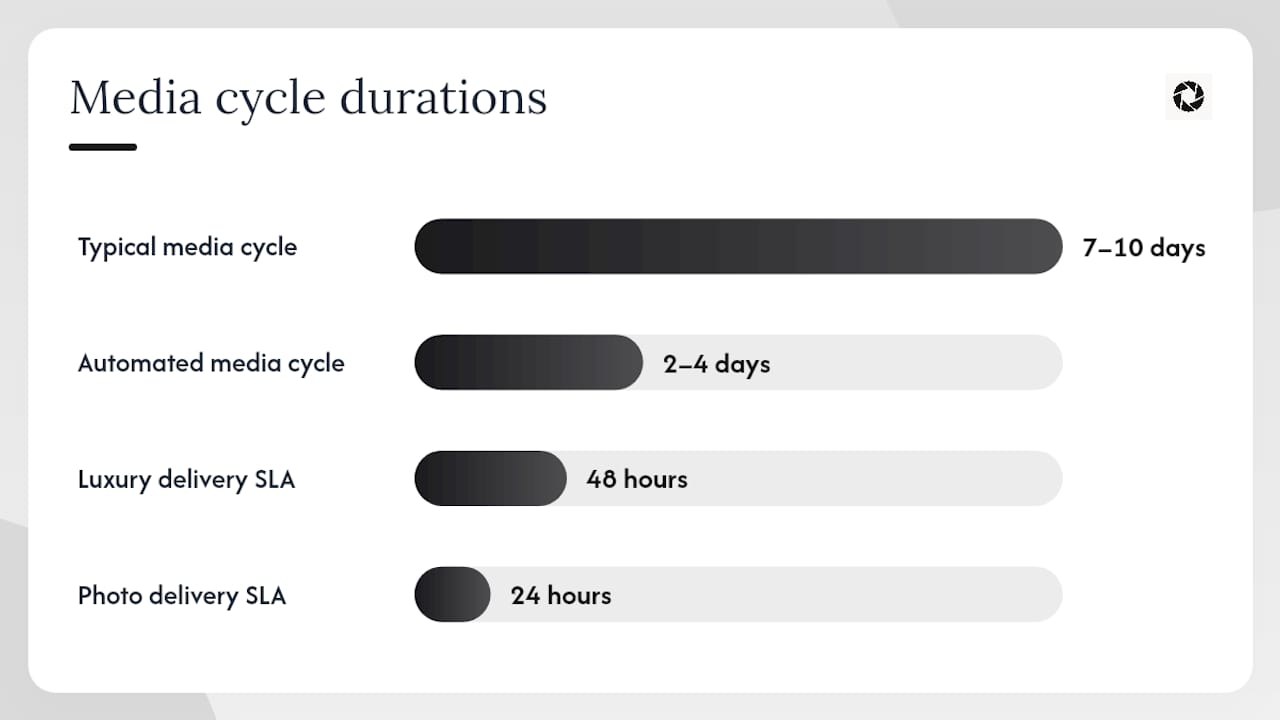
Automating photo scheduling and preparation reduced listing-to-photos time from 4.2 days to 1.1 days in operational case data, with re-shoot rates dropping from 12% to 3%. The gains came almost entirely from eliminating manual coordination steps, not from faster photographers.
Key factors that stretch timelines beyond the estimates above:
- Owner approval loops that add 1–2 days per round
- Staging or cleaning not completed before the shoot
- Photographer no-shows requiring rescheduling
- Manual MLS upload replacing automated distribution
How slow photo delivery cascades into real revenue loss
The delay is rarely one thing. It is a chain. A typical serial dependency looks like this:
- Listing agreement signed
- Agent emails photographer (same day or next day)
- Photographer checks availability (1–2 days)
- Shoot scheduled (adds 2–3 days to find a mutual window)
- Owner prepares property (variable, often unconfirmed)
- Shoot occurs
- Photographer edits and delivers (1–3 days post-shoot)
- Agent reviews and requests revisions (1–2 days)
- Final images approved
- MLS upload triggered manually
- Listing goes live
That chain routinely runs 11–14 human actions across 7–10 days. Each handoff is a potential stall point.
A concrete example: a $450,000 property delayed by five days loses its first-week view spike. A 4–5 day photo delay is associated with a -2.8% average price impact in marketplace models. On a $450,000 property, that is $12,600 in price erosion, before accounting for the extended days-on-market carrying costs.
The most common root causes, in order of frequency:
- No confirmed shoot date at time of signing
- Owner or cleaner not briefed on preparation requirements
- Photographer delivers late with no SLA in place
- Manual MLS upload adds a day after images arrive
Pro Tip: Treat the shoot date as a hard deadline, not a soft target. Send the preparation checklist to the owner the same hour you confirm the shoot, not the day before.
Nine steps to shorten photo turnaround and publish on time
A repeatable workflow eliminates the coordination gaps that cause most delays.
- Trigger scheduling the moment the listing agreement is signed, not the next business day.
- Maintain a ranked list of two or three photographers per market so you can dispatch immediately if your first choice is unavailable.
- Send an automated preparation checklist to the owner or cleaner within one hour of scheduling.
- Confirm the shoot 24 hours in advance with a reminder that includes the checklist again.
- Set a written delivery SLA: photos delivered within 24 hours of shoot completion.
- For phone or owner-submitted images, route to AI enhancement the same day rather than waiting for a shoot slot.
- Use automated MLS distribution so images publish within one hour of approval, not the next morning.
- Build a conditional branch for luxury listings: if the property exceeds a set price threshold, route automatically to a premium photographer with a 48-hour delivery SLA.
- Log timestamps at each step in your CRM so you can identify where delays recur.
Automating a listing media readiness checklist compresses typical media cycles from 7–10 days to 2–4 days by ensuring scheduling and pre-shoot preparation happen immediately at agreement, not reactively.
Current HospitalityLens pricing (USD); one-time packs — The Hero: 1 photo for $12; The Refresh: 10 photos for $59; The Property: 25 photos for $129; The Portfolio: 100 photos for $399; monthly subscriptions — THE STARTER: 10 photos/month for $49/month; THE OPERATOR: 25 photos/month for $99/month; THE PORTFOLIO: 100 photos/month for $299/month; one-time pack credits do not expire; monthly subscription credits remain valid for up to 3 months; 2 free revisions per photo on one-time packs; 3 free revisions per photo on monthly subscriptions. See current pricing.
When should you choose AI enhancement over a professional shoot?
The decision comes down to what the raw images can support and what the listing requires.
| Dimension |
AI enhancement |
Professional photoshoot |
Hybrid approach |
| Turnaround |
Same day to 24 hours |
3–7 days typical |
1–3 days (shoot + same-day enhance) |
| Cost per photo |
$3–$7 |
$10–$25 (post-edit) |
$8 combined |
| Fidelity |
Realistic improvement of existing space |
New angles, architectural capture |
New capture + polished output |
| Best use cases |
Refreshes, onboarding, phone images, seasonal updates |
Flagship launches, luxury, drone, twilight |
New listing with tight deadline |
| Revisions |
2–3 included |
1–2 rounds, varies by contract |
Depends on each vendor |
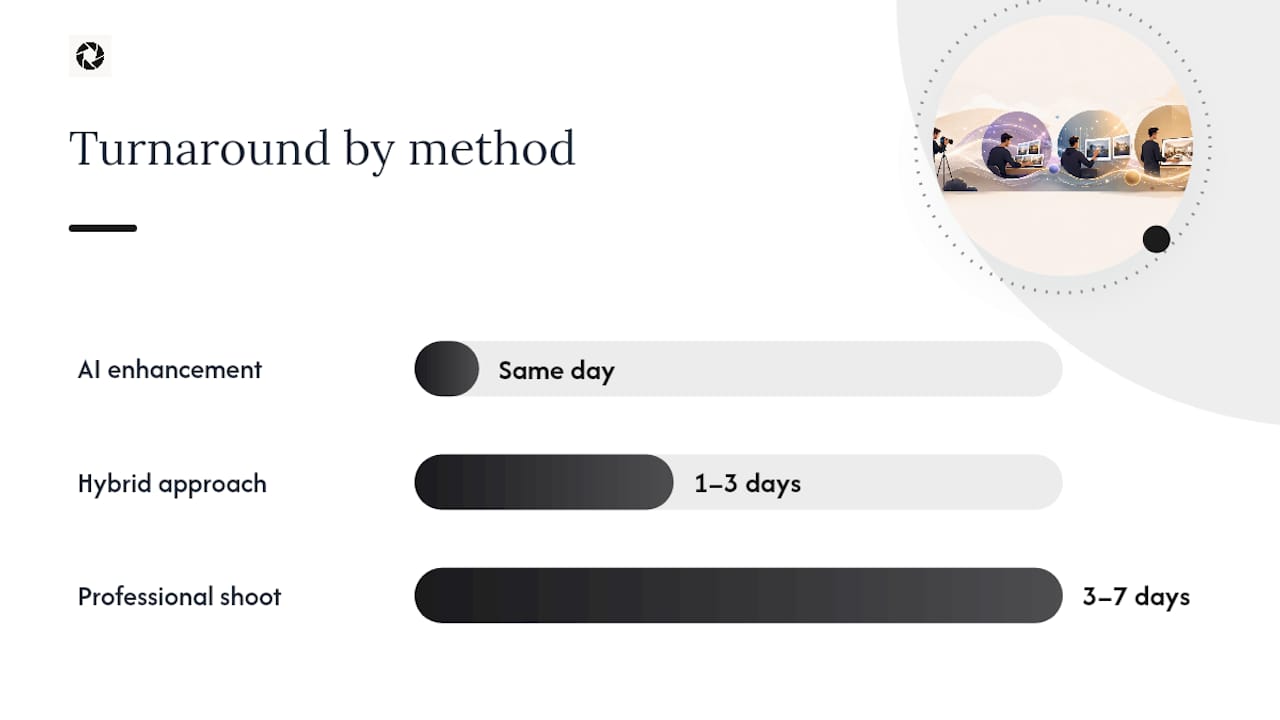
Use AI enhancement when your raw images show the real space clearly, even if they are dark, crooked, or cluttered. Use a professional shoot when you need angles that do not exist yet, architectural detail, drone coverage, or twilight exteriors. The hybrid path, a quick shoot followed by same-day enhancement, works well for new listings with a hard launch deadline.
For vacation rental photo editing that needs to go live within hours, AI enhancement is the practical choice when the originals are usable.
Pro Tip: Never use AI enhancement on photos that misrepresent the property. If the original image hides a structural issue or invents a view, enhancement makes the problem worse, not better. Honest images protect your reviews.
How to set SLAs and image rights before work begins
Verbal agreements on turnaround do not hold. Build these terms into every vendor agreement or internal SOP.
Sample SLA terms to include:
- Delivery window: edited images delivered within 24 hours of shoot completion (48 hours for luxury or drone shoots)
- Re-shoot allowance: one free re-shoot if more than 30% of images are unusable due to photographer error
- Publish-to-MLS maximum: listing live within 2 hours of final image approval
- Penalty clause: a defined credit or fee reduction for each day delivery exceeds the SLA
Revision policy template:
- Two rounds of revisions included; each round responded to within 4 business hours
- Rapid-accept path: a single-click approval option for same-day launches when images meet the brief
Image rights checklist:
- Confirm usage rights cover MLS, Airbnb, Vrbo, Booking.com, and your direct-booking site before accepting delivery
- Watermarked previews are acceptable for internal review only; never publish a watermarked image to a live listing
- Master files transferred to you on final payment, not held by the photographer
Pro Tip: Add a one-line image rights clause to your standard listing agreement so ownership is settled before the shoot, not after a dispute.
KPIs to track after tightening your photo workflow
Faster photos only matter if you can measure the result.
| KPI |
What it measures |
Target threshold |
| Listing-to-photos time |
Days from signing to images ready |
Under 2 days |
| Photos-to-MLS time |
Hours from image approval to listing live |
Under 2 hours |
| First-week views |
Platform views in days 1–7 |
Benchmark against prior listings |
| Saves rate |
Saves divided by views in week one |
Track trend, not absolute |
| Days on market |
Total days from list to contract |
Compare pre/post workflow change |
| Photographer fill rate |
Shoots completed within SLA |
More than 80% |
| Re-shoot rate |
Shoots requiring a second visit |
Below 5% |
Track listing and media step timestamps in your CRM. A simple dashboard showing average listing-to-photos time by photographer and by property type will surface your slowest links within two weeks.
For a property listing image optimization process that connects these KPIs to your publishing pipeline, a documented workflow makes SLA compliance visible rather than assumed.
Listings that publish with booking-ready photos on day one capture a disproportionate share of first-week views, and that early engagement is difficult to recover once the algorithm deprioritizes a listing.
Estimated ROI from faster photo delivery
The numbers are worth making concrete.
- A 4–5 day photo delay is associated with a -2.8% average price impact in marketplace models.
- On a $450,000 property, that is $12,600 in price erosion per listing.
- At a 2.5% commission, the agent’s share of that loss is $315 per listing.
- Across a portfolio of 40 listings per year, the revenue at risk from consistent photo delays reaches $12,600 in price erosion per listing multiplied across affected properties.
For short-term rental operators, the math runs differently but the direction is the same. An 11.0% bookings lift from optimized photo layout, applied to a property generating $3,000 per month, represents $330 in additional monthly revenue, or roughly $4,000 per year per listing.
The operational side compounds the financial case. Automating photo scheduling reduced listing-to-photos time from 4.2 days to 1.1 days in case data. At 40 listings per year, recovering three days per listing returns 120 staff-hours to other work.
What actually moves the needle when launch times are slipping
The instinct when timelines slip is to push the photographer harder. That rarely works. The real bottleneck is almost always the coordination layer: the gap between signing and scheduling, the owner who was not briefed, the MLS upload that waited until morning.
The teams that consistently publish within 48 hours do three things differently. They trigger scheduling the same hour the agreement is signed, not the next day. They send preparation instructions automatically, so the owner or cleaner knows exactly what is needed before anyone picks up a camera. And they treat AI enhancement as a legitimate first-publish option when the raw images are honest and usable, rather than holding the listing until a shoot slot opens.
The luxury exception is real. A flagship property with architectural detail, drone coverage, or twilight requirements needs a professional shoot. Trying to shortcut that with phone images, even well-enhanced ones, will show in the final result. But for the majority of listings, especially refreshes, seasonal updates, and owner-onboarded properties, the bottleneck is not photo quality. It is photo speed.
Measure publish time and first-week views in week one after any workflow change. Those two numbers will tell you whether the change worked faster than any other metric.
HospitalityLens gets your listing live without waiting for a shoot
When your raw images are usable, waiting days for a photographer slot is a choice, not a requirement. HospitalityLens enhances dark, crooked, cluttered, or owner-submitted photos into booking-ready listing images, with lighting and color correction, perspective fixes, clutter removal, and overall polish, while keeping the real property intact. No invented rooms, no fabricated views.
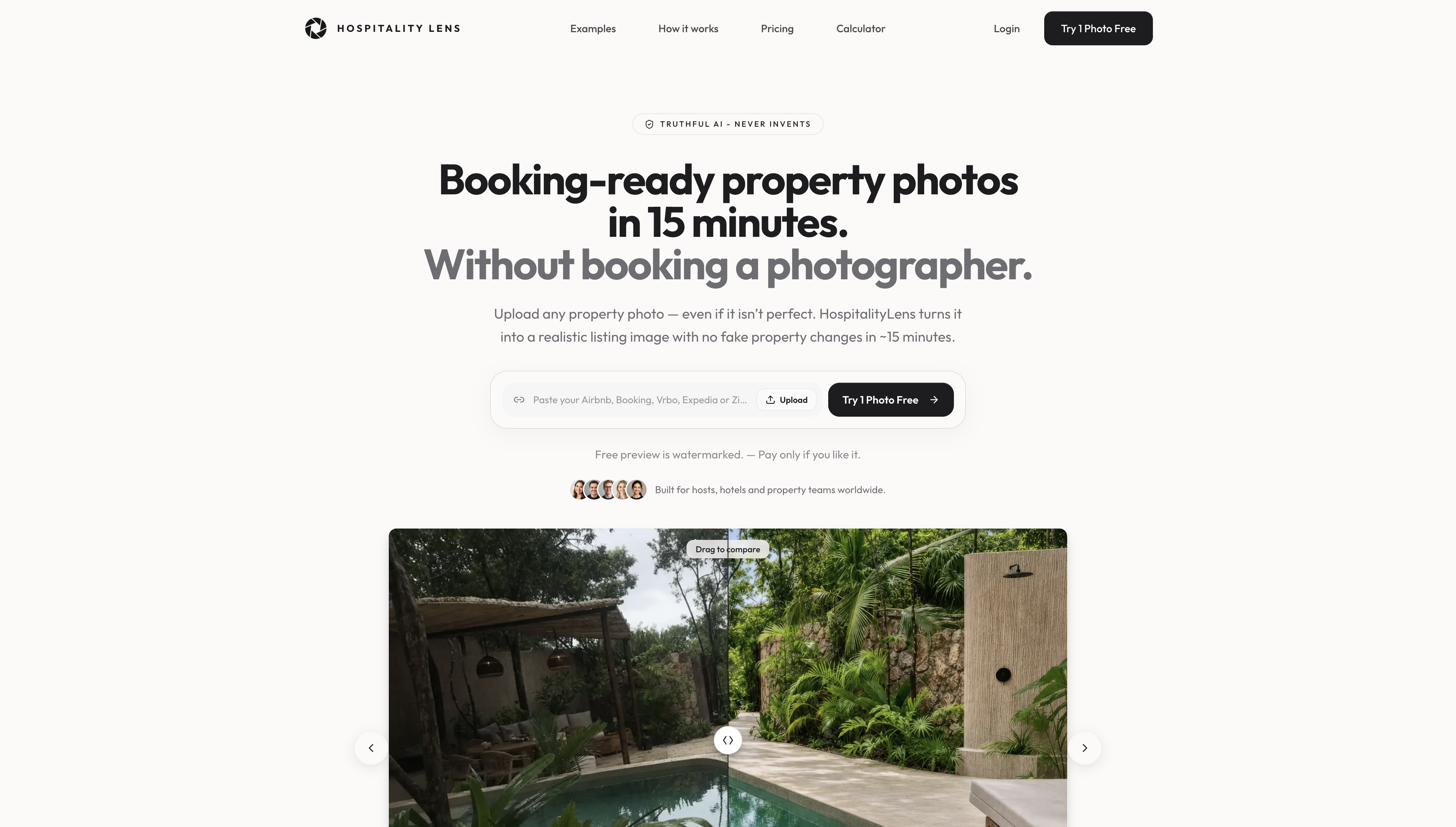
Free watermarked preview. Pay only if you like it. No card is required to create the free watermarked preview. See current pricing for unlocks, one-time packs, and subscriptions.
HospitalityLens is not a replacement for a professional shoot when you need new angles, drone work, or architectural capture. It is the practical option when you already have the images and need them listing-ready today. Try one photo free and see the output before committing, or follow the step-by-step guide to integrate it into your listing workflow.
Sources
The core research and operational analyses supporting this guide:
FAQ
How does photo turnaround time affect a listing’s publish date?
Photo turnaround is the single variable that sets your earliest possible publish date. Until booking-ready images are ready, the listing cannot go live, and every day of delay costs first-week views that platform algorithms do not restore.
What is a realistic turnaround time for AI photo enhancement?
AI enhancement typically delivers results the same day or within 24 hours. Services like HospitalityLens process uploaded images and return enhanced, listing-ready photos without scheduling a shoot.
When is a professional photoshoot worth the longer turnaround?
Book a professional shoot when you need angles that do not exist in the current images, architectural or drone coverage, twilight exteriors, or when the original photos are unusable. For refreshes and onboarding with usable raw images, AI enhancement is faster and sufficient.
What KPIs should I track after improving my photo workflow?
Track listing-to-photos time, photos-to-MLS time, first-week views, saves rate, and re-shoot rate.
How much revenue is at risk from a 4–5 day photo delay?
On a $450,000 property, that translates to $12,600 in price erosion per listing.
Recommended