Hotels
What Is On-Demand Hotel Photography? A 2026 Guide
Unlock increased bookings and guest satisfaction by effortlessly updating your hotel's online presence with stunning, professionally enhanced images.
By Hospitality Lens · · 11 min read
TL;DR:
- On-demand hotel photography offers flexible, fast image updates that improve listing performance and guest perception. It replaces infrequent full-day shoots with cost-effective, AI-enhanced images available within hours or days. Regular updates help properties maintain current visuals, boost visibility, and increase bookings.
On-demand hotel photography is defined as a flexible imaging service that delivers professional, booking-ready property photos without requiring a scheduled full-day shoot. Unlike traditional hotel photo shoots, which lock you into a single session every few years, on-demand services let you capture, enhance, and publish updated images whenever your property changes, your season shifts, or your listing needs a refresh. Photography shapes guest perception more than price or reviews, making it the most direct lever property managers have over booking performance. For hospitality teams managing multiple listings across Booking.com, Expedia, or direct-booking sites, that flexibility is not a luxury. It is a competitive requirement.
What is on-demand hotel photography, and how does it differ from traditional shoots?
Traditional hotel photo shoots follow a familiar pattern: hire a photographer, block off a full day, spend $400–$1,200 or more, and receive a set of images that you use for the next two to five years. That model made sense when listings were static. It does not hold up when OTA algorithms reward frequent image updates and guest expectations shift with every season.
On-demand hotel photography, also called on-demand hotel imaging, breaks that cycle. You request images when you need them, not on a fixed annual schedule. The service can cover a single room refresh, a new amenity addition, or a full seasonal reset. Turnaround times are measured in hours or days, not weeks.
The cost structure is also different. Traditional shoots are a single large investment. On-demand services spread cost across smaller, more frequent updates. A competent shoot lasts 2–5 years before visuals age, but seasonal updates through on-demand services maintain freshness without repeating the full upfront expense.
AI photo enhancement plays a central role in on-demand hotel imaging. Services that include AI editing can correct lighting, fix crooked horizons, remove clutter, and deliver polished images from photos taken with a smartphone or a basic camera. That means you do not need a professional photographer on-site every time.
- Scheduling: Traditional shoots require advance booking and full-day access. On-demand services work around your availability.
- Frequency: Traditional sets are replaced every few years. On-demand imaging supports quarterly or monthly refreshes.
- Cost per update: Traditional shoots carry a fixed day rate. On-demand pricing scales with the number of images you need.
- Editing depth: On-demand services often include AI enhancement, color correction, and perspective fixes as part of the workflow.
Pro Tip: If you manage more than five listings, treat photography as an ongoing operating cost, not a one-time capital expense. Budget for quarterly image reviews the same way you budget for cleaning or maintenance.
How does on-demand hotel photography work in practice?
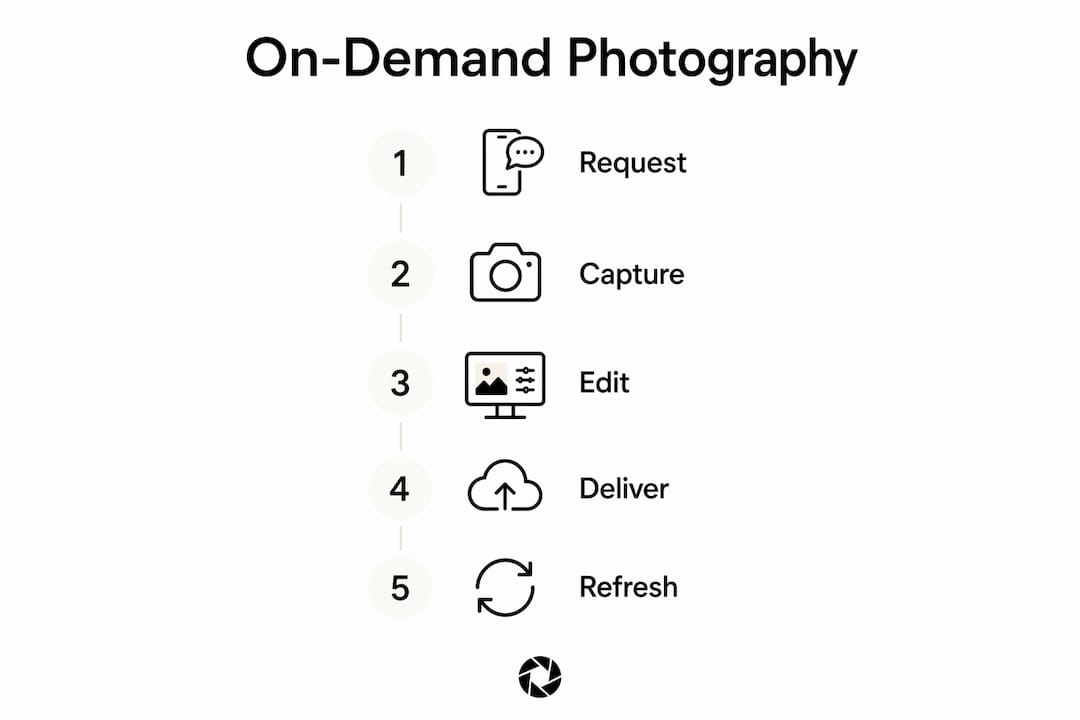
The workflow for on-demand hotel photography is straightforward. Understanding each step helps you plan updates efficiently and avoid common delays.
- Capture the images. A staff member, cleaner, or on-site photographer takes photos using a smartphone or camera. Natural light, honest framing, and a tidy room are the baseline requirements. Skilled mobile photography can outperform outdated professional photos for mid-market properties when executed with care.
- Upload to the service. You submit the raw images to your chosen on-demand provider. Most services accept standard JPEG or PNG files. No special equipment or file format is required at this stage.
- AI enhancement and editing. The service applies lighting and color correction, perspective and horizon fixes, clutter removal, and overall visual polish. This step transforms a usable photo into a booking-ready image without altering the real property.
- Review and revisions. You receive the enhanced images and request any adjustments. Quality providers include at least two free revision rounds per image.
- Delivery with commercial usage rights. Final images are delivered in formats optimized for OTA platforms and direct-booking sites. Image file optimization to formats like 4K WebP under 400KB is critical for web speed and conversion on direct booking sites.
- Publish across channels. You upload the final images to Booking.com, Expedia, Vrbo, Airbnb, or your hotel website. Updated images go live within your listing’s standard refresh window.
The entire process, from raw upload to published listing, can complete in under 24 hours with the right provider. That speed matters when you are responding to a renovation, a seasonal change, or a drop in click-through rate.
What are the measurable benefits of on-demand hotel photography for property listings?
The business case for professional hotel photography is well established. Properties with 20+ high-quality images per room see booking increases of 136% compared to properties with fewer images. That is not a marginal improvement. It is the difference between a listing that fills and one that sits.
“Guests form their first impression mostly based on images, not reviews or price. The listing photo is emotional before it is rational. A guest decides whether to click before they read a single word of your description.”
OTA algorithms amplify this effect. OTA platforms reward properties with professional images by boosting click-through rates and search rankings. Poor or dark photos act as negative signals, reducing your property’s visibility before a single guest even sees your price. On-demand imaging lets you correct those signals quickly, without waiting for a full shoot to be scheduled.
The revenue math is direct. A 1% improvement in OTA conversion on a $2,000,000 annual revenue portfolio equals $20,000 in additional revenue per year. On-demand photography services cost a fraction of that figure. The ROI case closes fast, especially for independent properties paying OTA commissions of 15–25% who benefit most from direct booking conversion improvements.

Seasonal image refreshes deliver a specific and often overlooked benefit. Seasonal updates reduce guest expectation gaps by accurately reflecting current decor and amenity condition. A guest who books based on accurate, current photos arrives with calibrated expectations. That reduces negative reviews and improves repeat booking rates.
Strong visual content also improves OTA rankings through higher engagement signals. When guests click your listing more often and spend more time viewing your images, the platform’s algorithm interprets that as quality. On-demand imaging gives you the ability to test and refresh images based on actual performance data, not guesswork.
What should property managers consider when selecting an on-demand hotel photography service?
Choosing the right on-demand hotel photography service requires more than comparing price per image. The criteria below determine whether a service actually improves your listing performance or just delivers files.
- Image quality and editing depth. The service must correct lighting, color, perspective, and clutter. A provider that delivers lightly filtered photos without structural corrections will not move your conversion metrics.
- Turnaround time. Marketing agility depends on fast delivery. Look for services that deliver enhanced images within 24–48 hours. Longer turnarounds reduce the value of on-demand flexibility.
- Commercial usage rights. Every image you publish on an OTA or your hotel website requires commercial licensing. Confirm that the service grants full commercial rights with delivery. This is non-negotiable for professional use. Commercial photo enhancement for hospitality requires explicit licensing to avoid platform disputes.
- OTA format compliance. Booking.com, Expedia, and Airbnb each have image dimension and file size requirements. A service that delivers images in the wrong format adds work to your team. Confirm that the provider understands OTA photo best practices and delivers accordingly.
- Pricing model transparency. Understand whether you are paying per image, per session, or on a subscription. Per-image pricing works for occasional updates. Subscription models suit teams managing multiple listings with regular refresh needs.
- Revision policy. At least two rounds of revisions per image is the standard for quality providers. Fewer revisions mean you absorb the cost of corrections yourself.
Pro Tip: Before committing to a service, submit one or two test images. Evaluate the editing quality, turnaround time, and communication before purchasing a larger pack. Most reputable providers offer a single-image trial.
A common pitfall is ignoring the “real estate trap” in hotel photography. Focusing on room size rather than selling the guest experience through imagery is a documented mistake. Your images should communicate how the space feels, not just how large it is. A good on-demand service understands this distinction and edits accordingly.
Key Takeaways
On-demand hotel photography is the most cost-effective way for property managers to maintain fresh, booking-ready listing images without the constraints of traditional full-day shoots.
| Point |
Details |
| Definition matters |
On-demand hotel photography delivers professional images on a flexible schedule, not a fixed annual shoot. |
| Booking impact is significant |
Properties with 20+ quality images see booking increases of 136% versus listings with fewer photos. |
| OTA algorithms respond to image quality |
Poor photos reduce search visibility; updated professional images improve click-through and rankings. |
| Seasonal refreshes reduce bad reviews |
Accurate, current images align guest expectations and lower the rate of disappointed arrivals. |
| Service selection criteria are specific |
Evaluate turnaround time, commercial rights, OTA format compliance, and revision policy before committing. |
What the HospitalityLens team has learned about on-demand photography in practice
The conversation around on-demand hotel photography often focuses on speed and cost. Those matter. But the more important shift is what on-demand imaging does to your relationship with your own listings.
When you can update photos in 24 hours, you stop treating your listing as a fixed asset and start treating it as a living marketing channel. That mindset change is worth more than any single image improvement. We have seen property teams go from updating photos once every two years to refreshing specific rooms every quarter. The result is not just better images. It is a team that pays closer attention to how their property looks and how guests respond.
The honest reality is that on-demand photography is not a replacement for a well-planned professional shoot. A full shoot, done right, still produces the strongest hero images for your homepage and primary OTA listing. On-demand imaging fills the gaps: the room that was just renovated, the pool area in summer light, the lobby after a furniture update. It keeps your portfolio current without requiring you to restart from zero every time something changes.
We also want to be direct about what AI enhancement can and cannot do. It corrects real problems: dark rooms, crooked angles, cluttered surfaces, flat colors. It does not fabricate amenities or make a small room look like a suite. The goal is always a truthful image that a guest recognizes when they arrive. That trust is what drives repeat bookings, not a single impressive photo.
— The HospitalityLens Team
How HospitalityLens fits into your on-demand photography workflow
Property managers who need booking-ready images without scheduling a photoshoot use HospitalityLens to close that gap. You upload your existing photos, whether they were taken by a cleaner, an owner, or a previous photographer, and receive professionally enhanced images with full commercial usage rights.
Current HospitalityLens pricing (USD); one-time packs — The Hero: 1 photo for $12; The Refresh: 10 photos for $59; The Property: 25 photos for $129; The Portfolio: 100 photos for $399; monthly subscriptions — THE STARTER: 10 photos/month for $49/month; THE OPERATOR: 25 photos/month for $99/month; THE PORTFOLIO: 100 photos/month for $299/month; one-time pack credits do not expire; monthly subscription credits remain valid for up to 3 months; 2 free revisions per photo on one-time packs; 3 free revisions per photo on monthly subscriptions. See current pricing.
FAQ
What is on-demand hotel photography?
On-demand hotel photography is a flexible imaging service that delivers professionally enhanced property photos without a scheduled full-day shoot. Property managers submit raw images and receive booking-ready results, typically within 24–48 hours.
How does on-demand hotel imaging differ from a traditional photo shoot?
Traditional shoots are a single large investment covering a full property session every 2–5 years. On-demand services allow frequent, targeted updates at a lower per-session cost, with AI enhancement included.
Do on-demand hotel photos include commercial usage rights?
Quality on-demand services include full commercial usage rights with delivery. These rights are required to publish images on OTA platforms like Booking.com, Expedia, and Airbnb without licensing disputes.
How often should hotel listing photos be updated?
Seasonal updates are the standard best practice. Refreshing images quarterly, or after any renovation or amenity change, keeps listings accurate and reduces guest expectation gaps that lead to negative reviews.
Can AI-enhanced photos replace a professional hotel photo shoot?
AI enhancement improves existing photos but does not replace a well-planned professional shoot for hero images. The two approaches work best together: professional shoots for primary listing images, on-demand enhancement for ongoing updates and room-level refreshes.
Recommended