Hotels
How Professional Imagery Shapes Guest Expectations
Elevate your property's appeal and secure more bookings by harnessing professional imagery to positively influence guest perceptions and experiences.
By Hospitality Lens · · 18 min read
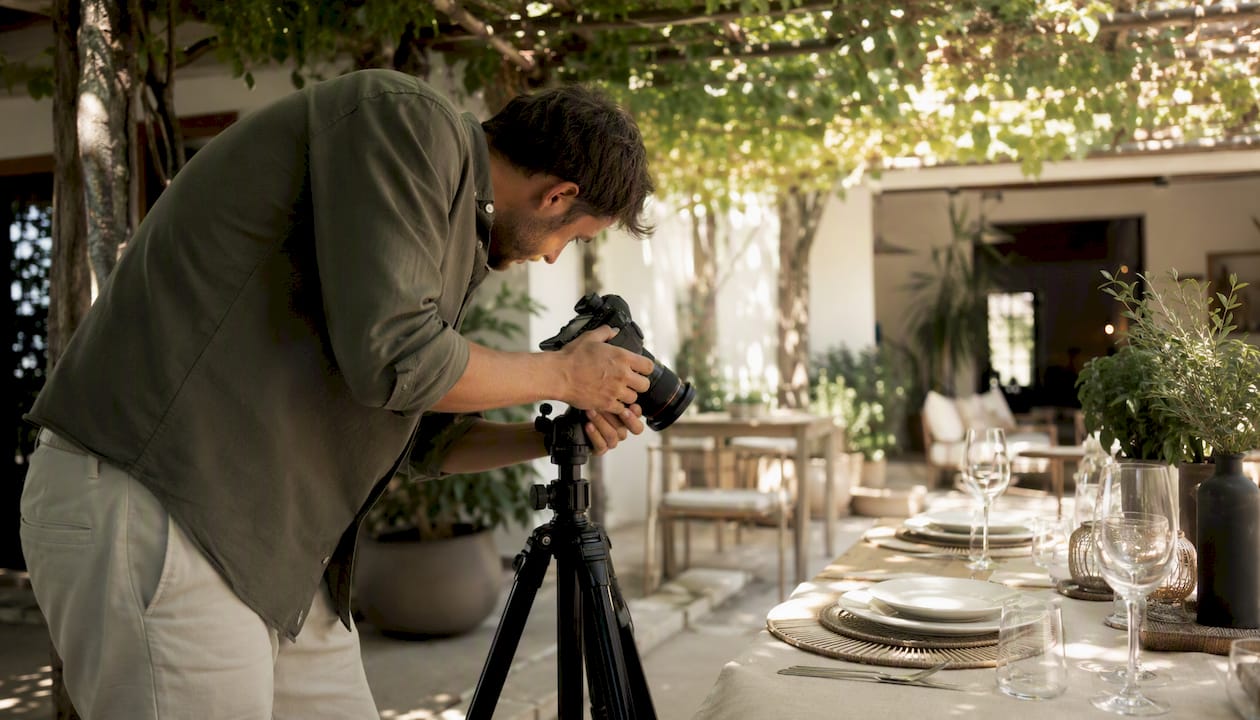
Cornell University research confirms what most property managers suspect but rarely act on: online hotel shoppers pay more attention to property images than to price, amenities lists, or star ratings when comparing venues. The photo is the first decision point. Before any guest reads a single sentence of your listing copy, they have already formed an emotional judgment about whether your property fits them. Understanding how professional imagery shifts guest expectations is the most direct lever you have over booking behavior, and it costs far less to address than most operators assume.
Key Takeaways
Professional imagery is the primary signal guests use to judge fit and value before they read a word of your listing, making photo quality the highest-leverage marketing investment most property managers are currently underusing.
Current HospitalityLens pricing (USD); one-time packs — The Hero: 1 photo for $12; The Refresh: 10 photos for $59; The Property: 25 photos for $129; The Portfolio: 100 photos for $399; monthly subscriptions — THE STARTER: 10 photos/month for $49/month; THE OPERATOR: 25 photos/month for $99/month; THE PORTFOLIO: 100 photos/month for $299/month; one-time pack credits do not expire; monthly subscription credits remain valid for up to 3 months; 2 free revisions per photo on one-time packs; 3 free revisions per photo on monthly subscriptions. See current pricing.
Table of Contents
Why visuals dominate first impressions
The human brain processes images in roughly 13 milliseconds, well before conscious reasoning kicks in. That speed means your listing photo is emotional before it is rational. Guests are not analyzing your square footage; they are feeling whether the space looks safe, clean, and worth the rate.
A peer-reviewed study published in Nature identified four specific image properties that predict positive guest perceptions and booking intent: lighting and time of day, color scheme, human presence, and shooting angle. These are not aesthetic preferences. They are signals guests read to estimate quality, service level, and whether the experience will match what they pay.
Here is what each cue communicates:
- Lighting: Bright, natural light reads as clean and spacious. Dark or uneven lighting suggests neglect or a space smaller than described.
- Shooting angle: A slightly elevated, wide-angle shot makes rooms feel generous. A low, tight angle makes them feel cramped.
- Color palette: Warm, cohesive tones signal care and intentionality. Clashing or washed-out colors suggest the space was photographed as an afterthought.
- Human presence: A lifestyle image with a person in frame helps guests imagine themselves in the space, which increases emotional connection and booking confidence.
- Clutter: Any visible clutter, even minor, triggers doubt about cleanliness standards.
- Scale cues: Furniture placement and props (a book on a nightstand, a coffee cup on a table) give guests a sense of real dimensions.
The role of photography in guest experience extends well beyond the listing thumbnail. Visuals set the expectation ceiling. When the real property matches or exceeds those visuals, satisfaction follows. When it falls short, complaints follow.
How better photos move the business needle
The impact of professional imagery shows up across several measurable metrics. Each one responds differently, and knowing which to watch helps you prioritize where to invest.
| Metric |
Why it changes with better imagery |
How to measure |
Realistic test window |
| Listing click-through rate (CTR) |
Thumbnail quality is the primary driver of clicks on OTAs and search results |
OTA analytics dashboard, Google Search Console |
2–4 weeks |
| Booking conversion rate |
Guests who click convert at higher rates when gallery images confirm the thumbnail’s promise |
Booking platform reports, direct-site analytics |
4 weeks |
| Average daily rate (ADR) |
Higher perceived value from polished images supports rate increases without volume loss |
Channel manager or PMS revenue reports |
within 90 days |
| Time on listing page |
Richer galleries keep guests engaged longer, which correlates with higher intent |
Google Analytics, heatmap tools |
2–4 weeks |
| Cancellations and complaints |
Accurate, consistent photos reduce expectation gaps that drive post-arrival disputes |
Review scores, cancellation rate in PMS |
within 90 days |
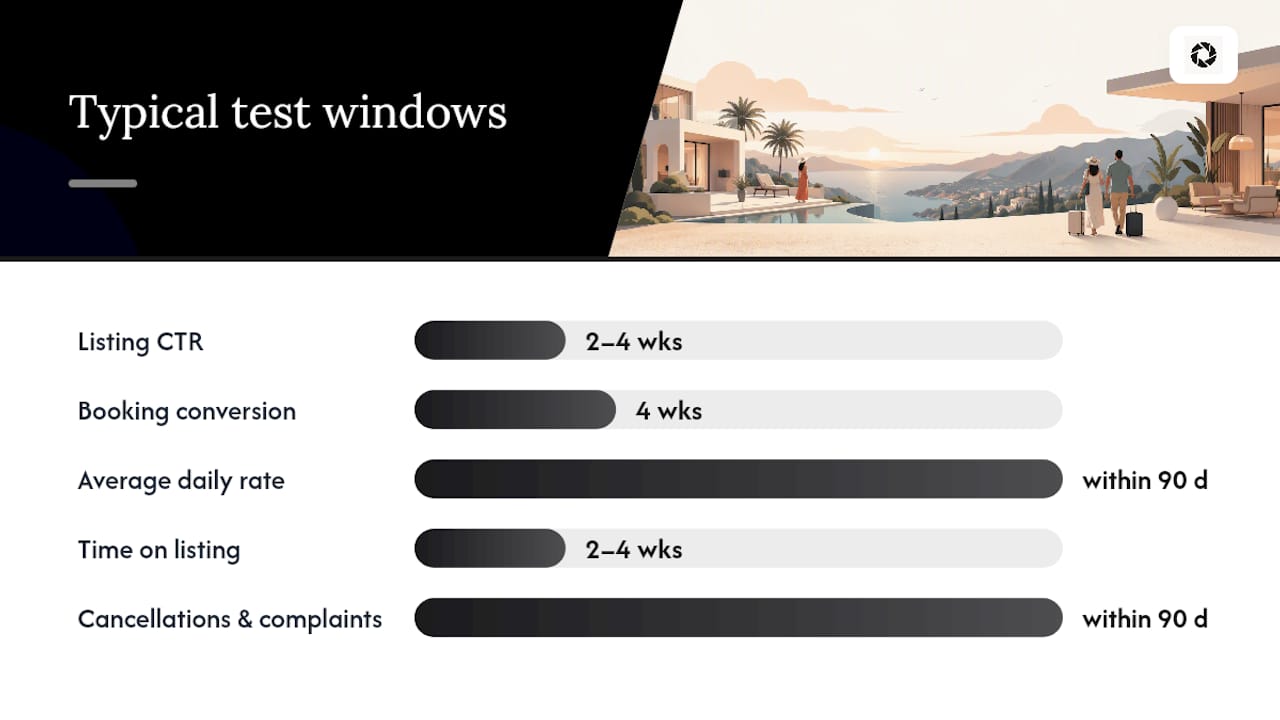
Hotel listing photos that attract more clicks tend to share one trait: the hero image delivers a clear, honest promise that the gallery then keeps. That alignment, not just image quality in isolation, is what moves conversion.
A practical note on effect sizes: results vary by channel, price tier, and how poor your baseline photos are. A boutique property moving from phone snapshots to well-lit, composed images will see a larger lift than a property that already has decent photos. Set realistic expectations before you run a test.
Common photography mistakes that mislead guests
Poor imagery does not just fail to attract bookings. It actively sets wrong expectations, which generates complaints, bad reviews, and cancellations that cost more than a photo refresh would have.
- Outdated photos: A room renovated two years ago still showing pre-renovation images creates an immediate trust gap when guests arrive. Guests feel misled even when the current space is better.
- Misleading crops and angles: Shooting a corner of a room to hide a low ceiling or a cramped layout is a short-term tactic with long-term consequences. Guests notice, and they say so in reviews.
- Overediting: Heavy filters, sky replacements, or color grading that makes a modest room look like a design hotel creates expectations the property cannot meet. Academic guidance is clear: embellishment that raises expectations beyond what the property delivers increases disappointment.
- Poor lighting and visible clutter: A single dark or cluttered photo in a gallery can undermine an otherwise strong set. Guests assume the worst-looking image is the most honest one.
- Inconsistent visuals across channels: Different photos on your website, Booking.com, and Airbnb create confusion and erode trust. Cloudbeds guidance lists accurate, consistent online listings as a foundational factor in managing guest expectations and reducing dissatisfaction.
Pro Tip: Run a quick self-audit by searching your property on every channel you list on, then screenshot the first image a guest sees on each. If the hero image differs across channels, or if any image is more than 18 months old, those are your first two fixes.
What a photo shoot or photo refresh should deliver
Whether you are briefing a photographer or preparing images for AI enhancement, a clear shot list keeps the output consistent and complete.
Priority shot list:
- Hero exterior or lobby shot (the image that appears as the thumbnail)
- Each room type: bedroom, bathroom, living area, kitchen (one wide establishing shot per space, one detail shot)
- F&B spaces: dining room, bar, outdoor terrace (food photography matters here; controlled research links visual presentation of food directly to consumer desire and selection behavior)
- Amenities: pool, gym, spa, workspace, parking
- Experience or lifestyle shots: a guest reading by a window, a set breakfast table, an outdoor seating area at dusk
- Views: from windows or balconies, shot at the time of day when they look best
Technical specs to confirm:
- Minimum resolution: 3000 x 2000 pixels for OTA uploads; most platforms accept JPEG at 72–96 DPI for web display
- Aspect ratios: 3:2 for most OTAs; 16:9 for website hero banners; 1:1 for Instagram
- Lighting: natural light preferred; shoot interiors between 10 AM and 2 PM or use supplemental lighting to avoid mixed color temperatures
- Horizon and perspective: keep vertical lines straight; a tilted horizon reads as careless
- Props and staging: fresh towels, a made bed, a single decorative item; clean, but not sterile
What counts as acceptable enhancement vs. what crosses the line:
Correcting exposure, straightening a crooked horizon, removing a cleaner’s cart from the frame, or brightening a dark corner are honest improvements. Adding a view that does not exist, widening a room beyond its real dimensions, or replacing furniture with virtual staging that is not present are misleading. The standard is simple: the enhanced photo should match what a guest sees when they walk in.
Rights and metadata checklist:
- Confirm usage rights cover all channels (website, OTAs, social, paid ads) before publishing
- Name files descriptively (property-name_room-type_angle.jpg) for internal organization
- Write alt text that describes the space accurately for accessibility and SEO
When to hire a photographer, and when AI enhancement is smarter
The right production path depends on what you already have and what you need.
|
Professional shoot |
AI photo enhancement |
DIY phone editing |
| Cost range |
$500–$3,000+ per property |
$3–$12 per photo |
Near zero |
| Turnaround |
Days to weeks (scheduling, editing) |
Hours to 1–2 days |
Immediate |
| Scalable volume |
Low (cost and scheduling limit scale) |
High (batch orders, no scheduling) |
Medium (time-limited) |
| Fidelity to reality |
High when briefed correctly |
High (truthful enhancement only) |
Variable |
| Revisions |
Depends on contract |
2–3 revisions per photo included |
Unlimited but skill-dependent |
| Best use cases |
Flagship launches, new builds, architectural shoots, unusable originals |
Listing refreshes, onboarding, phone/cleaner photos, portfolio consistency |
Minor crops, quick social posts |
Choose a professional photographer when you are launching a flagship property, need new angles that do not exist in your current photo set, or when the original images are simply unusable. For everything else, including seasonal refreshes, underperforming listings, owner-submitted or cleaner-taken photos, and portfolio-wide consistency, AI enhancement from existing images is faster and more cost-effective.
Pro Tip: Before hiring any vendor, ask three questions: What will you not change? (Honest vendors have a clear answer.) Who owns the final files? And does the price include revisions, or are those billed separately? The answers tell you more than the portfolio does.
HospitalityLens works from your existing photos, correcting lighting, perspective, and clutter without inventing features that are not there. You can try one photo free and receive a watermarked preview before committing to anything.
How to test photo changes and prove ROI
A structured A/B test is the most defensible way to quantify what better imagery is worth to your business.
Step-by-step test plan:
- Write a hypothesis. Example: “Replacing the current hero image on Listing A with a professionally enhanced version will increase CTR by a measurable amount over four weeks.”
- Choose one variable. Change only the hero image, not the price, copy, or availability. Isolating the variable is what makes the result meaningful.
- Select your channel. OTA listings are easier to test because platforms report CTR directly. Website A/B tests require a tool like Google Optimize or VWO to split traffic.
- Set a minimum test duration. Run the test for at least four weeks to account for day-of-week variation. For ADR or conversion tests, extend to eight weeks.
- Define primary and secondary KPIs before you start. Primary: CTR or booking conversion rate. Secondary: time on page, ADR, cancellation rate.
- Measure baseline first. Pull four weeks of pre-test data for the same listing so you have a real comparison point.
- Analyze and decide. If CTR improves and conversion holds or improves, the new image is working. If CTR rises but conversion drops, the new image may be attracting the wrong audience.
Common testing pitfalls to avoid:
- Changing price or copy during the test period contaminates the result
- Running the test across a major holiday or seasonal shift skews the data
- Comparing two different listings instead of the same listing over time introduces too many variables
- Declaring a winner after one week; most listing tests need at least 200–300 impressions per variant for meaningful signal
Prioritized next steps for property managers
The evidence is consistent: imagery is the primary filter guests use before they read anything else about your property. Here is a practical sequence to act on that.
- This week: Pull up your most-booked listing on every channel you use. Screenshot the hero image on each. If they differ, or if any image is dark, crooked, or more than 18 months old, that listing is your first project.
- Within 30 days: Run one A/B test on your highest-traffic listing using a refreshed hero image. Use the step-by-step plan above. Alternatively, upload one photo to HospitalityLens for a free watermarked preview to see what enhancement can do before spending anything.
- Within 90 days: Roll out a photo refresh across your top five to ten properties, prioritizing any with below-average CTR or above-average complaint rates. Use the shot list and technical specs from the production checklist above.
- Budget for a professional shoot when you are launching a new flagship property, when your existing photos are genuinely unusable, or when you need angles and lifestyle shots that do not exist in your current library.
How guest expectations have shifted as imagery standards have risen
Guest expectations do not exist in a vacuum. They calibrate against every listing a guest browses before yours. As OTA platforms have raised their image quality floors and as smartphone cameras have improved, the baseline a guest expects has moved steadily upward.
A decade ago, a well-lit phone photo was competitive. Today, guests scroll past listings with dark, cropped, or flat images because dozens of alternatives in the same search results look more polished. The importance of high-quality imagery has not changed in principle; what has changed is the threshold at which “good enough” actually is good enough.
This matters most for properties in competitive markets where price and location are similar across options. When reputation signals like reviews and ratings are close, imagery becomes a disproportionately strong tie-breaker. Research on appearance-based perceptions in online marketplaces confirms that “looking the part” raises selection likelihood even when it does not predict stronger performance. For newer properties or recently renovated rooms without a review base yet, this effect is especially pronounced.
Why professional photos affect perceived value and willingness to pay
The connection between image quality and price sensitivity is psychological, and it runs deeper than aesthetics. When a guest sees a polished, well-composed photo, they are not just admiring the image. They are inferring what the experience will feel like and whether it is worth the rate on the screen.
Visual storytelling research suggests that editorial-quality imagery helps guests imagine the experience and reduces the mental friction of committing to a booking. That reduction in decision friction translates directly into willingness to pay a premium, particularly for design-led or lifestyle-oriented properties.
Practitioners in hospitality photography consistently note that polished, consistent images justify higher rates and build trust, especially for boutique and higher-end properties where the visual presentation is part of the product itself. The photo is not just marketing. It is a sample of the experience.
What before-and-after results actually look like
Documented before-and-after results in hospitality photography tend to follow a recognizable pattern. A listing with dark, phone-taken photos and a low CTR gets a set of well-lit, composed images. CTR rises. Conversion holds or improves. Review scores stabilize because the property now matches what guests expected when they booked.
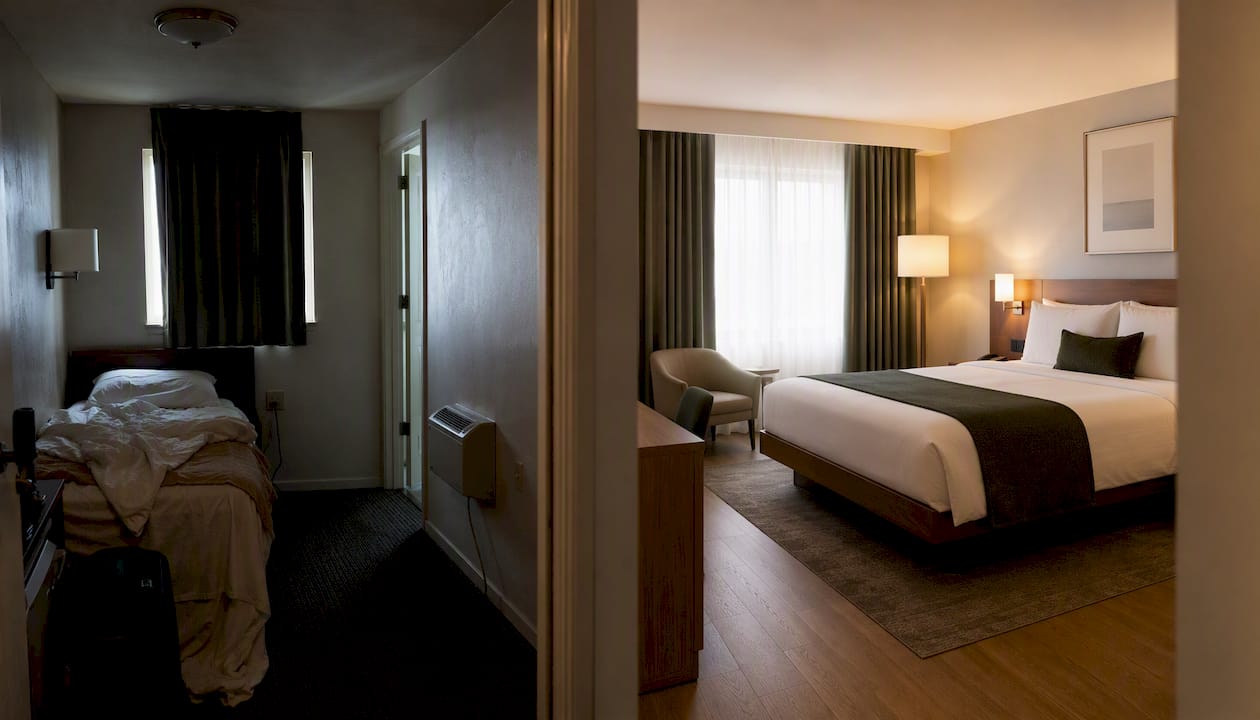
The Philip Castleton analysis of hospitality photography practice notes that lighting, angle, and composition determine whether a space reads as inviting, and that consistent visual presentation builds recognition and trust across channels over time. Properties that invest in coordinated photo sessions across interiors, F&B, and amenities see the compounding benefit of a coherent visual identity, not just a one-time CTR bump.
The most honest framing: better photos do not fix a bad product. But they do give a good product a fair chance to be seen and chosen.
Cost considerations and ROI of investing in photography
A professional property shoot typically runs $500–$3,000 or more depending on property size, location, and the photographer’s experience. For a single flagship property, that investment is often justified within one or two additional bookings at a competitive rate.
For portfolio managers handling ten, twenty, or fifty listings, the math shifts. A full shoot for every property is neither practical nor necessary. AI photo enhancement from existing images costs a fraction of a shoot, with one-time packs running $3.99–$5.90 per photo and monthly subscriptions starting at $2.99 per photo for high-volume teams. The ROI question becomes: how many additional bookings does one improved listing generate, and what is the average booking value?
Research on photo quality and hospitality revenue consistently points to CTR and conversion as the primary levers. The enhancement cost is recovered quickly when the baseline photo quality is genuinely poor.
Visual consistency across a portfolio also carries a compounding benefit. Adobe Research findings suggest that coordinated visuals across website, social, and OTA listings increase brand recognition over time, which supports direct booking rates and reduces OTA commission dependency.
The HospitalityLens approach to truthful image improvement
At HospitalityLens, the work starts with what you already have. Most property managers are sitting on usable photos that are simply underperforming because of correctable issues: a dark exposure, a crooked horizon, a cleaner’s bag in the corner of the frame. Those are fixable without a new shoot.
The service corrects lighting and color, straightens perspective, removes clutter and unwanted objects, and brings overall visual polish to images that already represent the real property. What it does not do is invent rooms, add views that do not exist, replace furniture with virtual staging, or create any detail that would mislead a guest about what they will find when they arrive. That boundary is not a limitation. It is the point. Guests who book based on accurate images arrive with calibrated expectations, and calibrated expectations are what generate good reviews.
For teams managing multiple listings, the free preview is a low-risk starting point. Upload one photo, receive a watermarked enhanced version, and decide whether the result justifies the next step.
Your first photo, free: see the impact before you commit
If your listings have phone photos, owner-submitted images, or a gallery that has not been updated in over a year, the fastest way to understand what improvement looks like is to see it on your own photo.
Current HospitalityLens pricing (USD); one-time packs — The Hero: 1 photo for $12; The Refresh: 10 photos for $59; The Property: 25 photos for $129; The Portfolio: 100 photos for $399; monthly subscriptions — THE STARTER: 10 photos/month for $49/month; THE OPERATOR: 25 photos/month for $99/month; THE PORTFOLIO: 100 photos/month for $299/month; one-time pack credits do not expire; monthly subscription credits remain valid for up to 3 months; 2 free revisions per photo on one-time packs; 3 free revisions per photo on monthly subscriptions. See current pricing.
The service fits best when you have phone or cleaner-taken photos that need correction, a listing that is underperforming on CTR or conversion, a new property to onboard quickly, or a portfolio that needs consistent visual quality across all channels. Start with the step-by-step guide to upload your first photo and see the result.
Sources
FAQ
How does professional imagery shift guest expectations before arrival?
Professional photos set the expectation ceiling for a guest’s stay. When images are accurate, well-lit, and composed to show the space honestly, guests arrive with calibrated expectations, which is the single strongest predictor of positive reviews.
Which image properties matter most for hospitality bookings?
A Nature peer-reviewed study identified lighting and time of day, color scheme, human presence, and shooting angle as the four properties that most reliably predict positive guest perceptions and booking intent.
What are the three C’s of hospitality?
Definitions vary across sources, but a widely used framework cites care, consistency, and communication as the three C’s: caring for guests’ needs, delivering a consistent experience, and communicating clearly at every touchpoint, including through accurate listing imagery.
Can AI photo enhancement replace a professional photographer?
For listing refreshes, onboarding, and portfolio consistency using existing usable photos, AI enhancement is a practical and cost-effective alternative. A professional photographer remains the better choice for flagship launches, new angles, architectural work, or when original images are unusable.
How long should a photo A/B test run before drawing conclusions?
Run a photo A/B test for at least four weeks to account for day-of-week variation, and extend to eight weeks when testing ADR or booking conversion. Aim for at least 200–300 impressions per variant before treating any result as meaningful.
Recommended